
The MPS 2026.1 Early Access Program Has Started

The MPS 2026.1 Early Access Program (EAP) is kicking off today. Download the first 2026.1 EAP release and give it a try!
Along with numerous bug fixes, this build introduces several key improvements.
Migration to IntelliJ Platform 2026.1, JDK 25, and Kotlin 2.3
This MPS 2026.1 EAP build completes the jump to the current generation of the IntelliJ Platform. The runtime is JDK 25, and the embedded Kotlin version is 2.3.0. Additionally, MPS now builds and ships its own kotlinx-metadata-klib / kotlin-metadata-jvm artifacts from the Kotlin repository at the matching 2.3.0 tag, restoring the KLib-based Kotlin stubs support that the last public kotlinx-metadata-klib:0.0.6 could no longer provide.
Ability to check ICheckedNamePolicy against specific natural languages
MPS now uses the IntelliJ Platform’s natural language support, provided by Grazie. This means you can check whether string values in instances of ICheckedNamePolicy, such as intentions, actions, or tools, have proper capitalization according to the rules of a specific natural language.
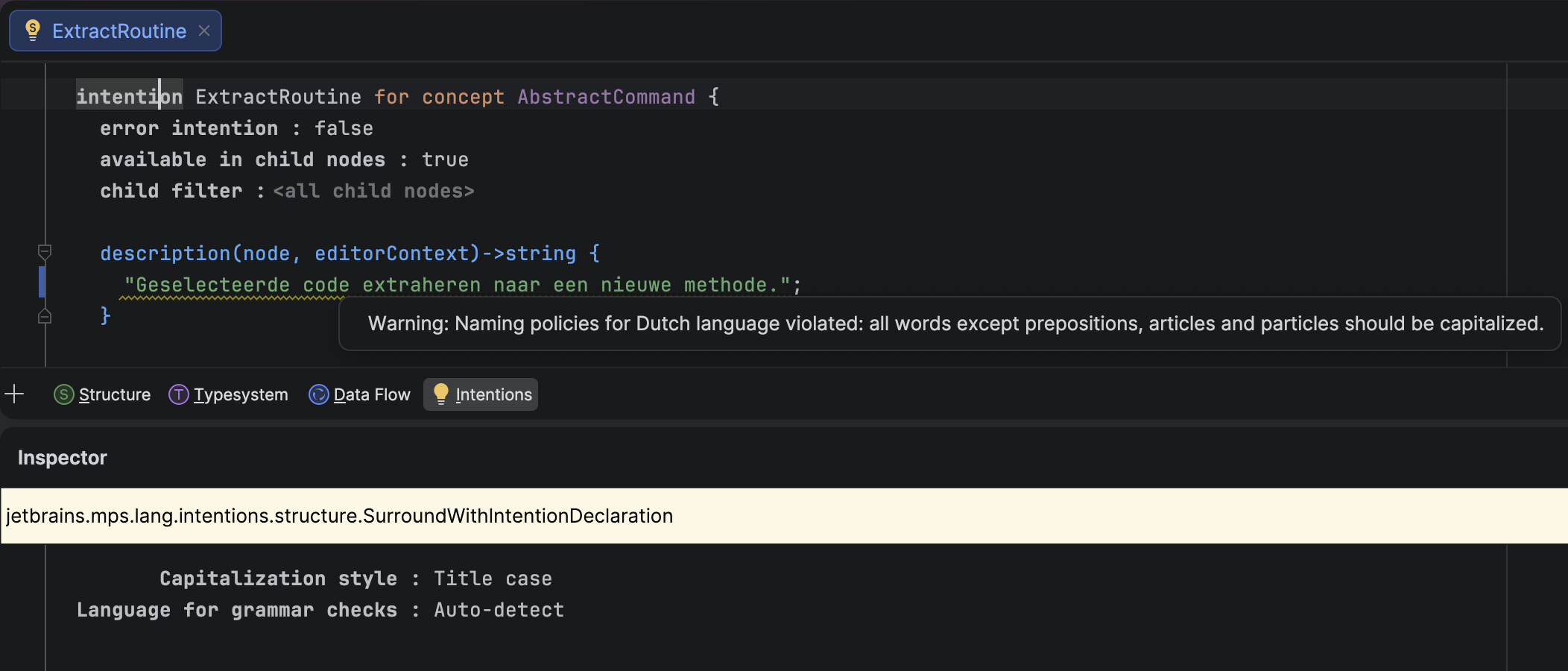
Thanks to this change, you can install natural language support for select languages into MPS, and the IDE will detect the language used in strings and verify that individual words are capitalized correctly. You can also bypass the language detection mechanism and specify your desired language explicitly.
In addition to the default Title-case capitalization rules, MPS offers three other options:
- Sentence-case, which follows the IntelliJ Platform’s rules
- Inherited, which uses the capitalization rules of the closest ancestor ICheckedNamePolicy
- No capitalization rules
Binary operations can be split into multiple lines
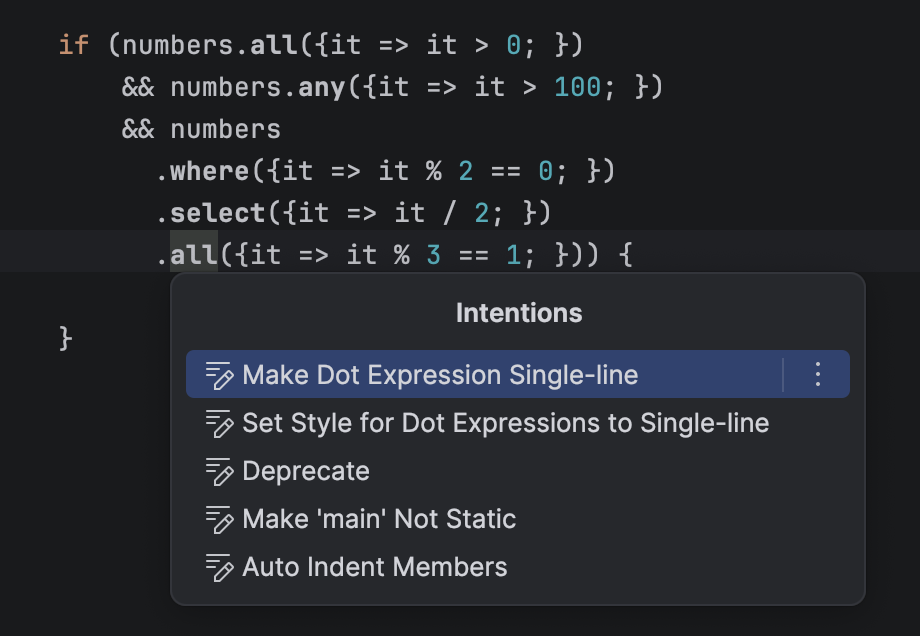
In the editor, you can now split long lines with binary operations. A dedicated intention action lets you toggle between the single-line and multi-line layouts for a given BinaryOperation.
New boolean editor style: read-only-inspector
The new read-only-inspector style enforces the read-only property on all editor cells in the inspector. When this style is applied to a cell in the main editor, the inspector becomes read-only for the inspected node when the cell with this style is selected. The new style has the following properties:
- It is disabled by default.
- The style is inheritable and overridable, just like the read-only style.
- It has no effect on main editor cells.
- The read-only style set by this mechanism can be overridden in any cell farther down the inspector editor cell tree.
Transitive dependencies in Build Language
Build Language no longer requires every transitively-reachable build script to be listed in dependencies. This means that a build script, BuildA, that depends on BuildB can now reach BuildC through BuildB (provided that BuildB depends on BuildC) without having to list BuildC explicitly. The generator emits ${artifacts.BuildC} Ant properties for such cases, and these properties can be supplied from the outer build tool (Gradle, Maven, etc.).
This lets you split large builds into smaller ones without forcing every user to update the dependency lists. For example, a single platform build script can wrap a growing set of external libraries used across sub-projects.
More reliable migrations via recorded dependencies
Migration code previously decided which migrations to apply based on the actual module dependencies and used languages collected at migration time, but it would read versions from the dependency snapshot recorded in the module descriptor. That mismatch could cause migrations to use a different view of the world than the one the module was last modified against.
In this 2026.1 EAP build, the migration machinery consistently uses the dependencies and used languages recorded in the module descriptor at the moment of last modification, not the currently observable state. The migration checker was refactored accordingly. It now reuses information already collected for the migration process instead of recomputing it on demand.
Improved Java stubs
A cluster of long-standing Java-stubs bugs has been fixed, visibly improving the accuracy of BaseLanguage stubs produced for imported .jar files and Java Sources model roots:
- MPS-33174 – Classes with InnerClasses attributes are now correctly transformed to BaseLanguage stubs (open since 2021). The signature’s inner-class information and parameterized owner types are preserved, so fields and methods of inner classes of generic outer classes now show the proper type instead of collapsing to the outer class.
- MPS-39375 – Type variables in generic methods of inner classes are now handled, so methods referencing type variables of the outer class no longer show java.lang.Object in place of the real type variable.
- MPS-39007 – The spurious Java imports annotation is present error no longer appears on every root of a Java source stub model.
- MPS-39565 – Java source stub roots no longer disappear on changes to the containing module’s properties, so references from project code to those roots stay intact when module properties are changed.
Modernized project lifecycle
With MPSProject having moved from a legacy IntelliJ IDEA ProjectComponent to a project service, MPS-aware features need a reliable way to be notified about MPSProject becoming available and going away.
This build introduces a dedicated mechanism for managing MPSProject startup and shutdown activities, giving MPS control over the sequencing, grouping, ordering, and threading of those activities. This was something the platform’s ProjectActivity / MPSProjectActivity could not offer.
How it works: Implementors register against the jetbrains.mps.project.lifecycleListener extension point (declared in MPSCore.xml) via a ProjectLifecycleListener.Bean with a listenerClass and an optional integer priority. The LifecycleEventDispatch.java inside MPSProject can fire:
- projectReady (non-blocking)
- projectDiscarded (blocking)
- asyncProjectClosed (non-blocking)
Wayland by default
MPS now offers Wayland as the default display protocol on supported Linux systems. When running in a Wayland-capable environment, MPS automatically switches to a native Wayland backend instead of relying on X11 compatibility layers, bringing it in line with modern Linux desktop standards.
This transition improves overall integration with the system, providing better stability across Wayland compositors, proper support for input methods and drag-and-drop, and more consistent rendering – especially on HiDPI and fractional scaling setups. While the user experience remains largely familiar, some differences (such as window positioning or decorations) may be noticeable due to Wayland’s architecture. X11 is still fully supported and can be used as a fallback when needed, ensuring compatibility across all Linux environments.
You can review the complete list of fixed issues here.
Your JetBrains MPS team