JetBrains Research
Research is crucial for progress and innovation, which is why at JetBrains we are passionate about both scientific and market research
2025 开发者生态系统调研:中国市场独家洞察

每年,数以万计的开发者投身于 JetBrains 开发者生态系统调研,帮助我们绘制全球软件开发的演进版图。这项调研以 8 种语言发布,汇集了来自 20 个国家和地区的数据。这其中,中国作为一个快速发展的市场,既与全球趋势保持同频,又保留着鲜明的本土特色。
例如,Java 在中国各行各业的普及率依然稳居高位——这一模式与全球趋势大相径庭,折射出中国庞大的移动互联网和企业级应用体量。与此同时,Go 和 TypeScript 采用率的攀升,也表明开发者正日益关注系统的可扩展性、开发体验以及现代 Web 架构。
感谢所有参与调研的开发者,让我们能够透过数据,深入观察中国开发者生态系统,并发掘出那些未曾在通用数据图表中披露的独家洞察。无论您身处中国市场,还是希望通过对比全球趋势来了解这片热土,我们都希望这些发现能为您带来启发。
中国软件开发趋势:细节决定差异
从宏观视角来看,中国开发者的画像与全球其他地区并无二致:拥有计算机科学背景的 STEM 毕业生,掌握着主流语言和工具,活跃在各行各业。但要真正理解这一市场的脉搏,我们必须透过表面看本质——正是这些细节,构成了中国市场的独特性。
1. Java 的统治地位
尽管 Java 在全球范围内依然是主流开发语言,但在中国,它的普及程度远超其他地区。
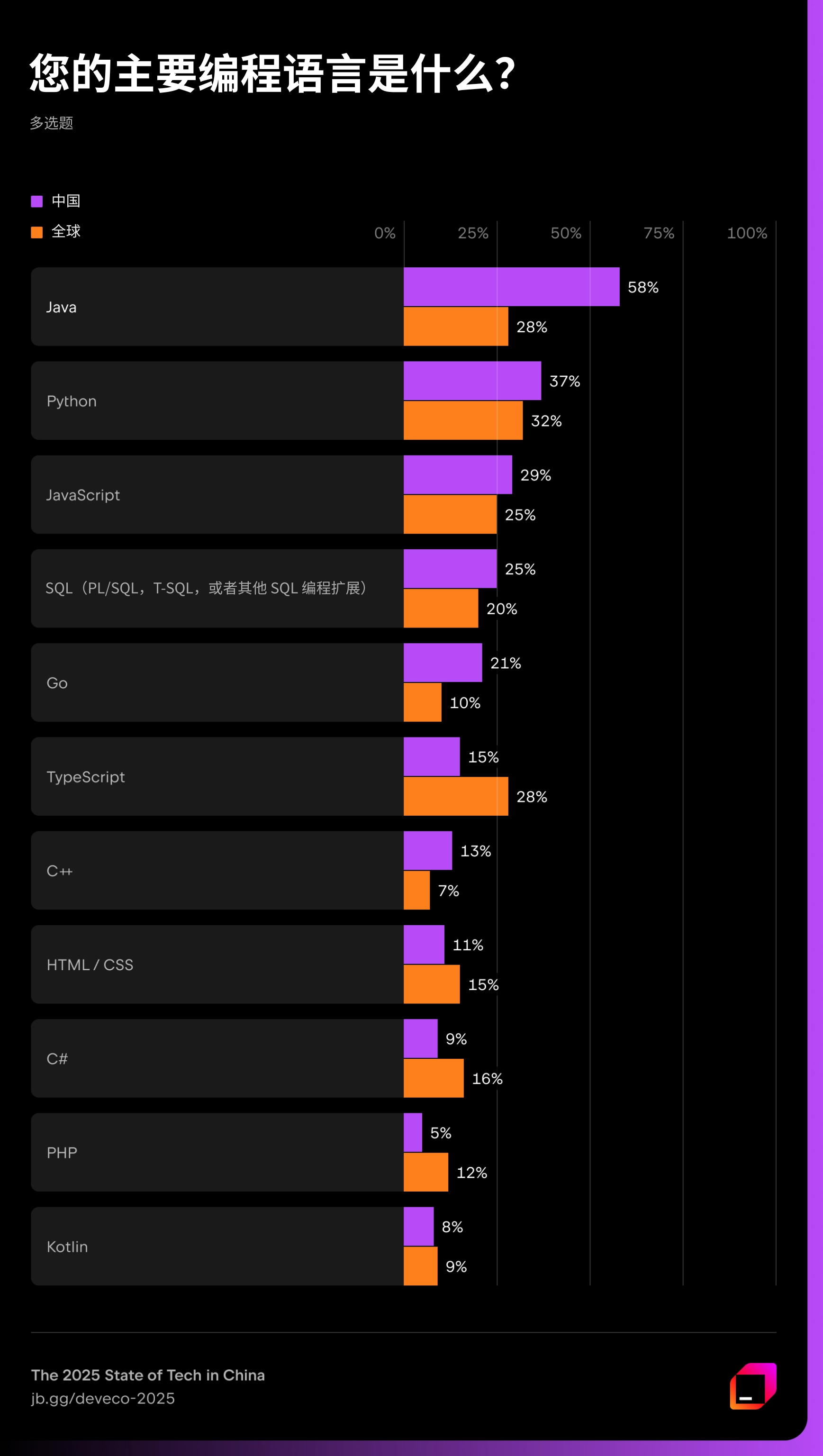
从全球平均水平来看,约 27.76% 的专业开发者将 Java 作为主要开发语言,与 JavaScript 和 Python 形成了相对平衡的“三足鼎立”之势。然而在中国,Java 的优势呈现断层式领先:它是 58.17% 中国开发者的首选语言。
“Java 在中国市场的统治地位,本质上是由互联网行业的爆发式增长及其随之确立的技术栈所驱动的。中国电商、金融科技和社交媒体浪潮中的初创企业,在早期阶段就将 Java 作为标准。它们基于 Spring 和 Apache Dubbo 等成熟框架,构建了核心的高并发、分布式系统。
这形成了一个庞大的生态系统和正向循环:企业选择 Java 是因为人才储备充足;开发者学习 Java 是因为就业机会丰富。
此外,Android 也是一个关键因素。在 Kotlin 成为首选语言之前,Android 智能手机在中国的海量普及,奠定了 Java 作为移动应用开发主要语言的地位,并进一步扩大了其开发者基础。”

2. 小程序开发普及 vs. 云服务开发的差异
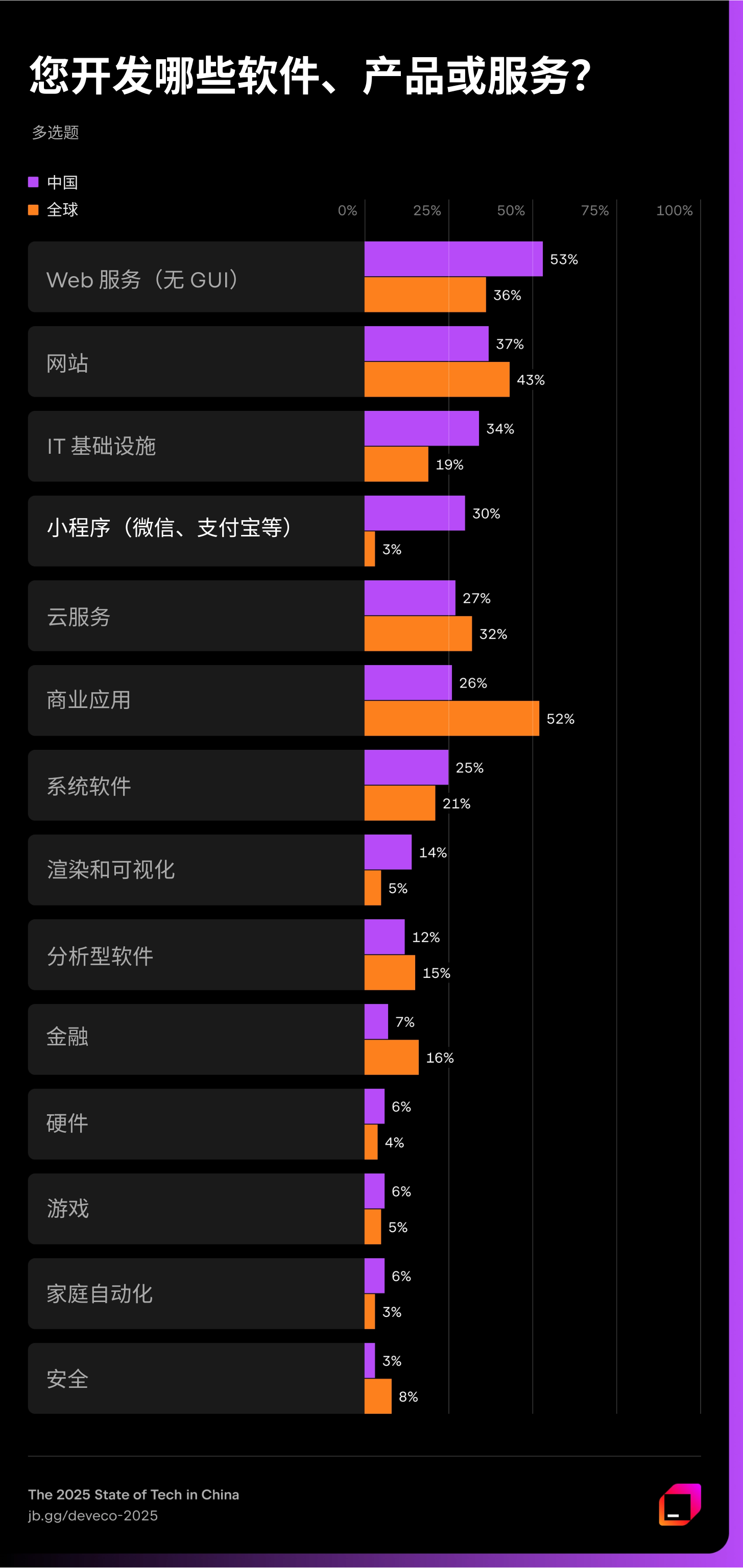
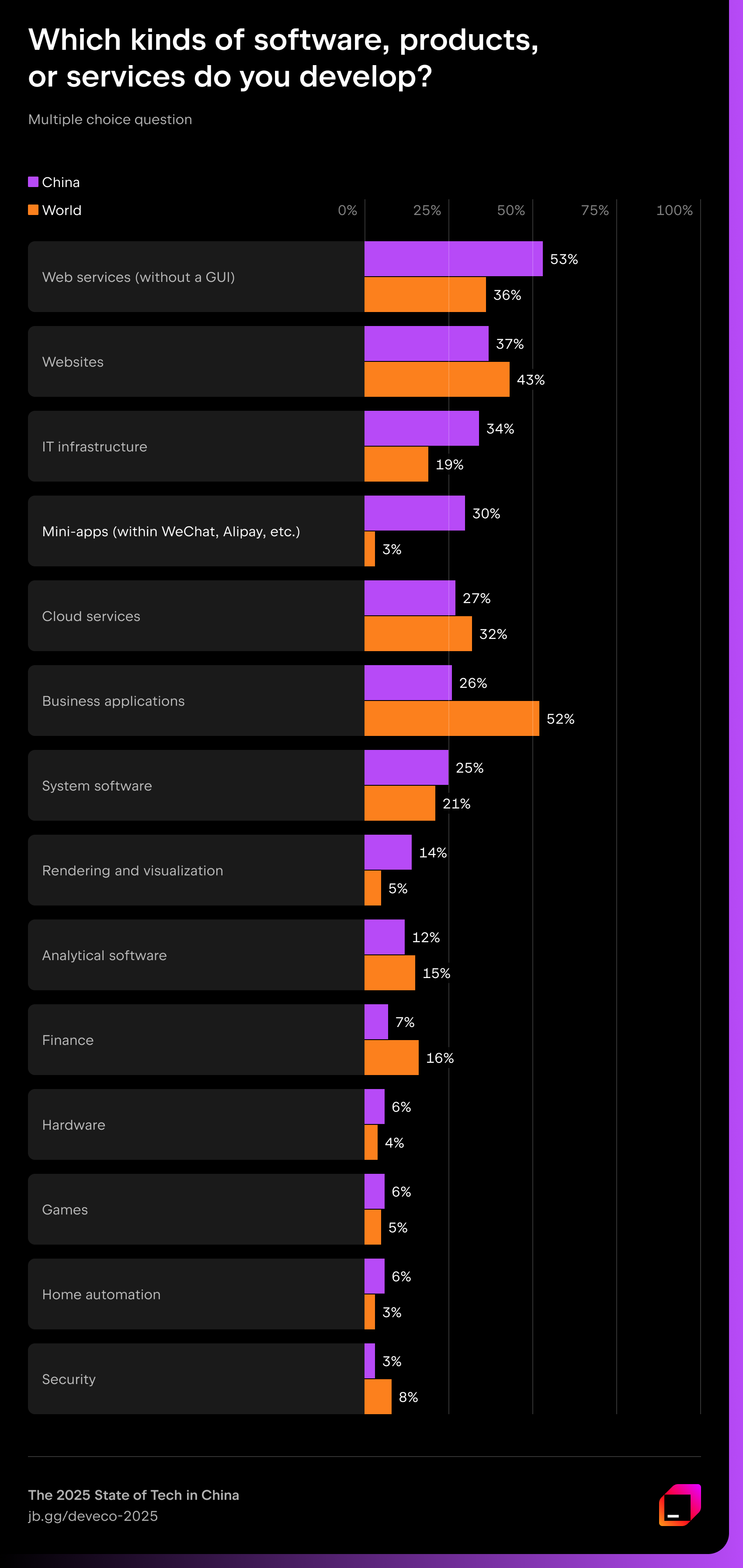
在《2025 开发者生态系统》报告中,中国开发者在小程序(Mini-apps)开发方面的参与度显著高于全球社区:30.27% 的中国专业开发者参与过小程序开发。其中最主流的解决方案是 uni-app (35.06%) 和 微信原生开发 (34.21%)。不过,也有 22.39% 的开发者对目前的工具生态表示了不满。
小程序早已深度融入了中国人的日常生活。从即时通讯、打车到外卖、政务办理,一个超级 App 就能承载万千服务。这些轻量级应用运行在大型平台之上,通常依赖于平台特定的框架(如微信小程序和 uni-app),结合了 JavaScript、自定义标记语言和类 CSS 样式。
去年,响应广大用户的需求,WebStorm 团队推出了备受期待的 WeChat Mini Program 插件,以支持微信原生开发。该插件原生支持 WXML、WXSS 和 WXS 语法,让开发者无需在微信开发者工具和主编辑器之间频繁切换,即可在 WebStorm 中流畅工作,同时也减少了查阅组件文档的时间。有关 WeChat Mini Program 插件 的更多内容,欢迎通过这篇博文了解。
3. 上市公司占比高于私营企业
我们的第三个观察点聚焦于开发者的工作环境及机构类型。数据表明,中国企业的分布结构与全球呈现出截然不同的图景。
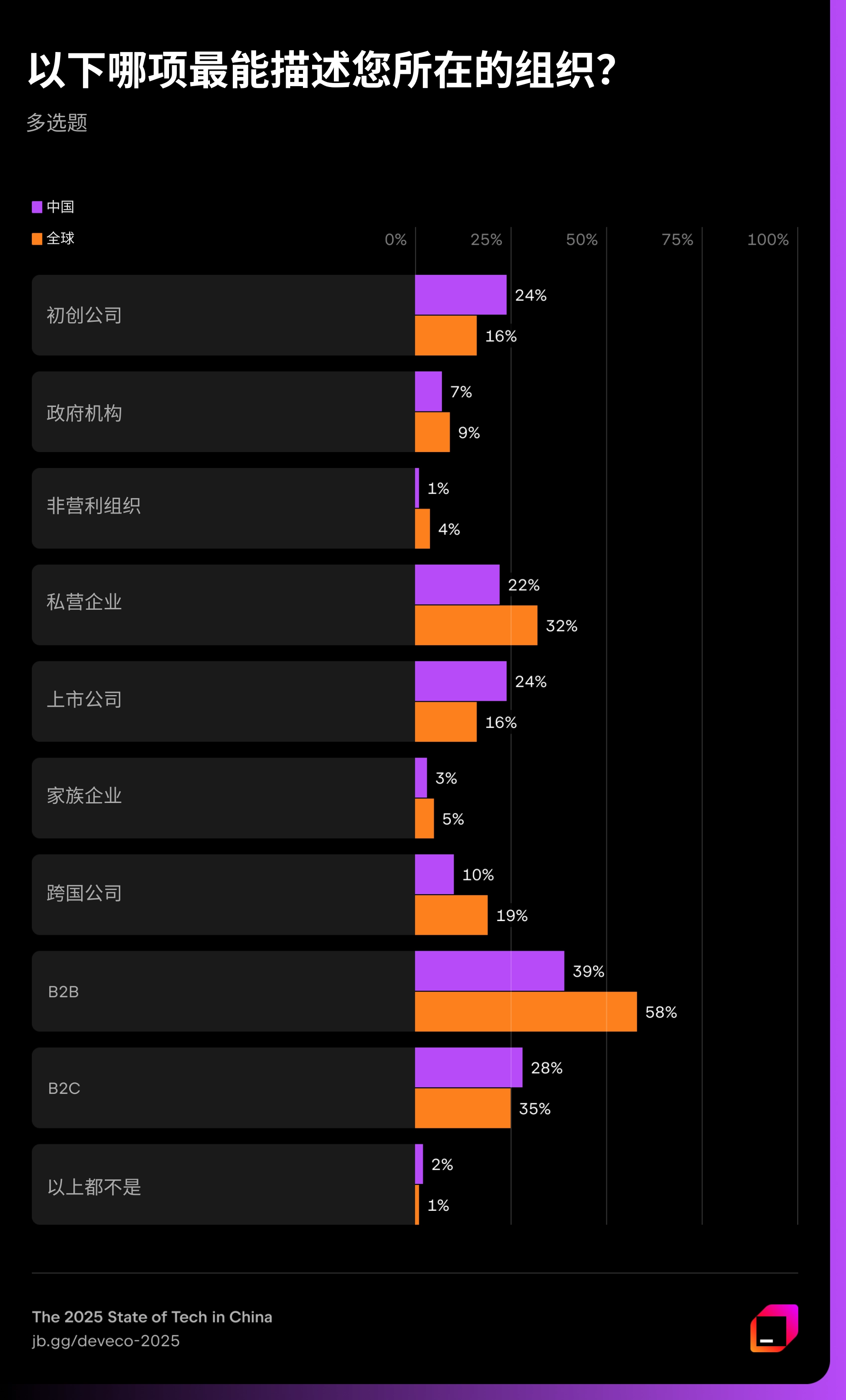
- 私营与上市公司: 中国受访者更多供职于初创公司 (24%) 和大型上市公司 (24%),这两个数字均高于全球平均水平(均为 16%)。而在所有权结构上差异更为明显——仅有 22% 的中国开发者在私营企业工作,而全球这一比例为 32%。
- 跨国公司: 仅有 10% 的中国开发者受雇于跨国公司,显著低于 19% 的全球平均水平。
- B2B vs. B2C: 业务导向也存在差异。在中国,39% 的开发者从事 B2B 业务,28% 从事 B2C 业务;相比之下,全球 B2B 占比高达 58%,B2C 为 35%。这表明中国市场具有更强的消费者导向 (Consumer-facing) 特征,开发者更多直接服务于终端用户产品。
4. 低代码 / 无代码的新视角
相比全球平均水平,中国开发者对低代码/无代码 (Low-code/No-code) 平台的态度更为积极。
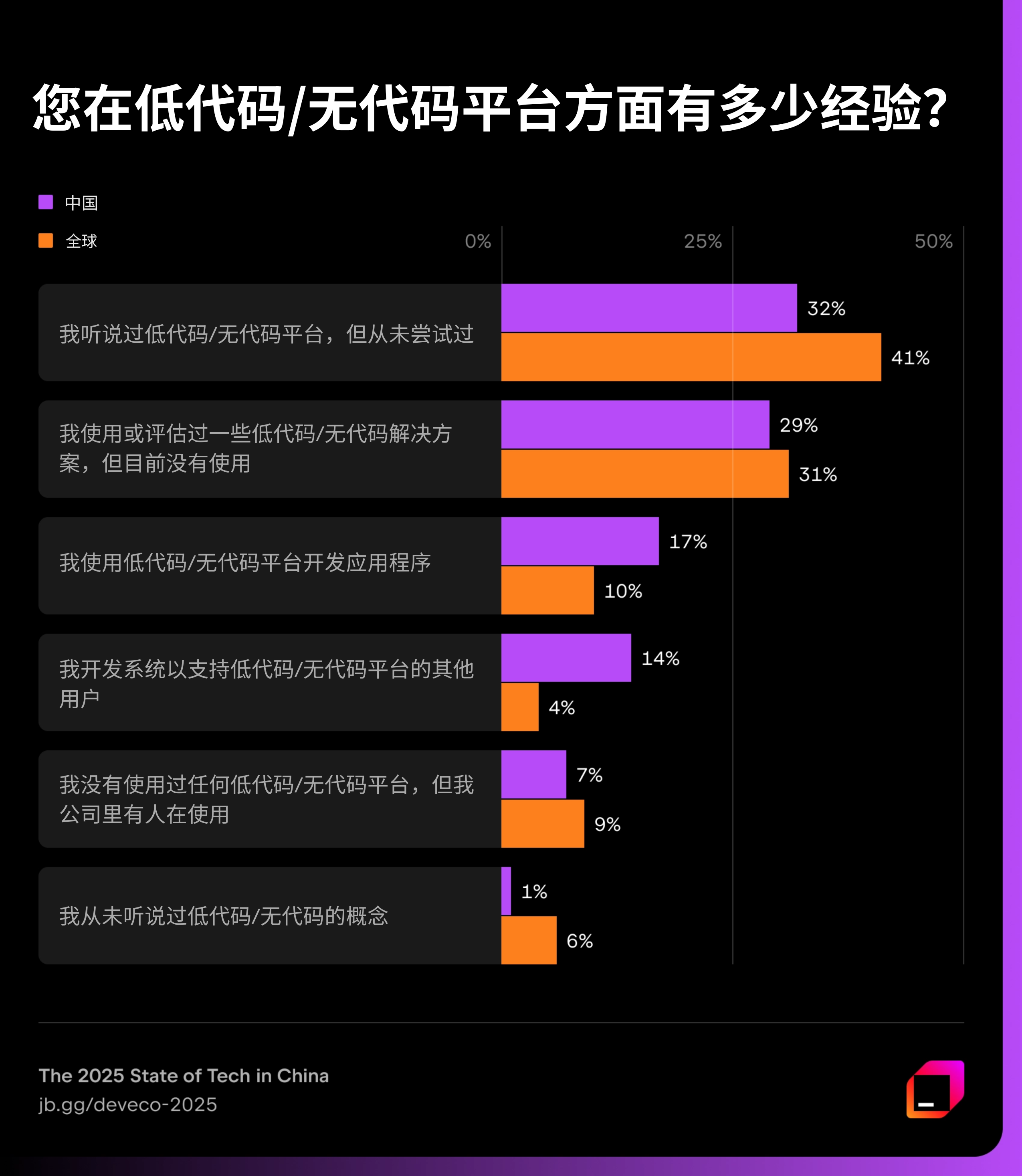
中国开发者不仅更倾向于使用这些工具构建应用(17% vs. 全球 10%),也更多地开发系统来支持他人使用(14% vs. 全球 4%)。无论在中国还是全球,业务流程自动化 (BPA) 都是首要用例。
最大的差距出现在网站和应用程序的构建上:30% 的中国受访者使用低代码/无代码工具来构建网站和应用,而全球这一比例仅为 17%。
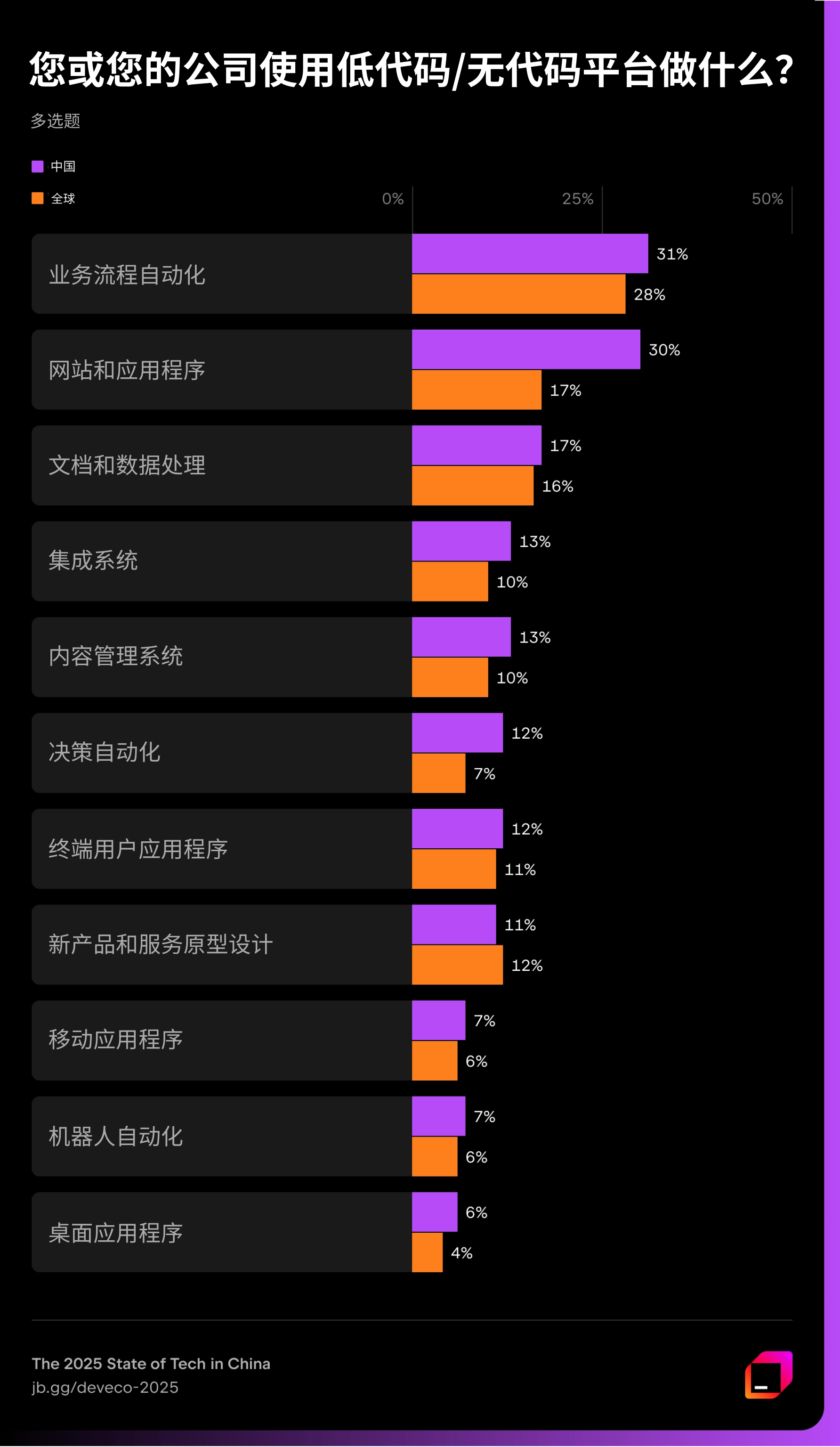
在全球范围内,低代码/无代码通常被视为业务流程管理和快速原型的工具。但在中国,它已成为生产力驱动文化的一部分——开发者不仅自己使用,还在通过这些工具赋能他人进行构建和自动化。
5. 中国的大语言模型 (LLM) 版图:本土与海外的博弈
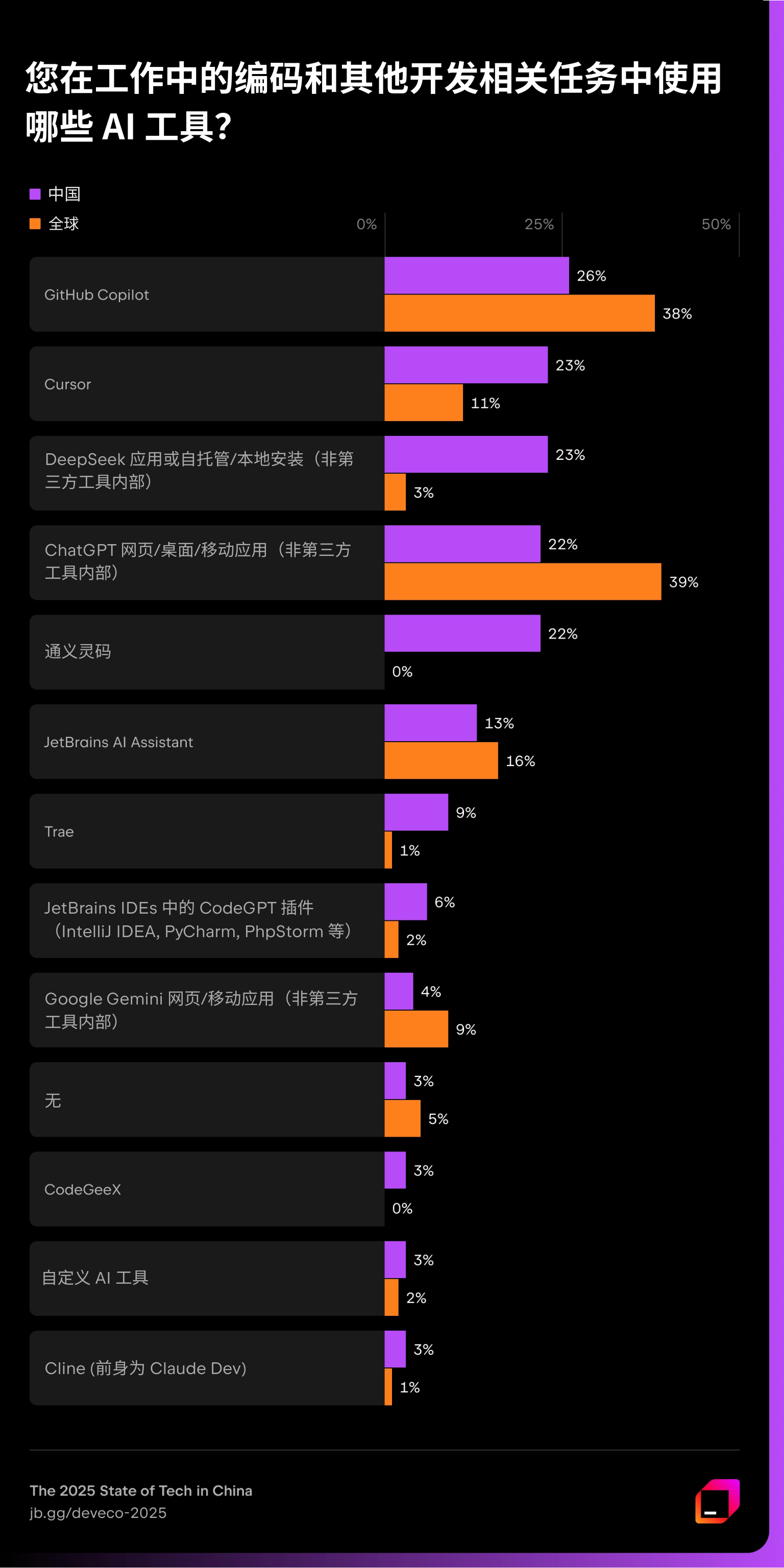
在 AI 工具的选择上,中国开发者表现出了独特的偏好。
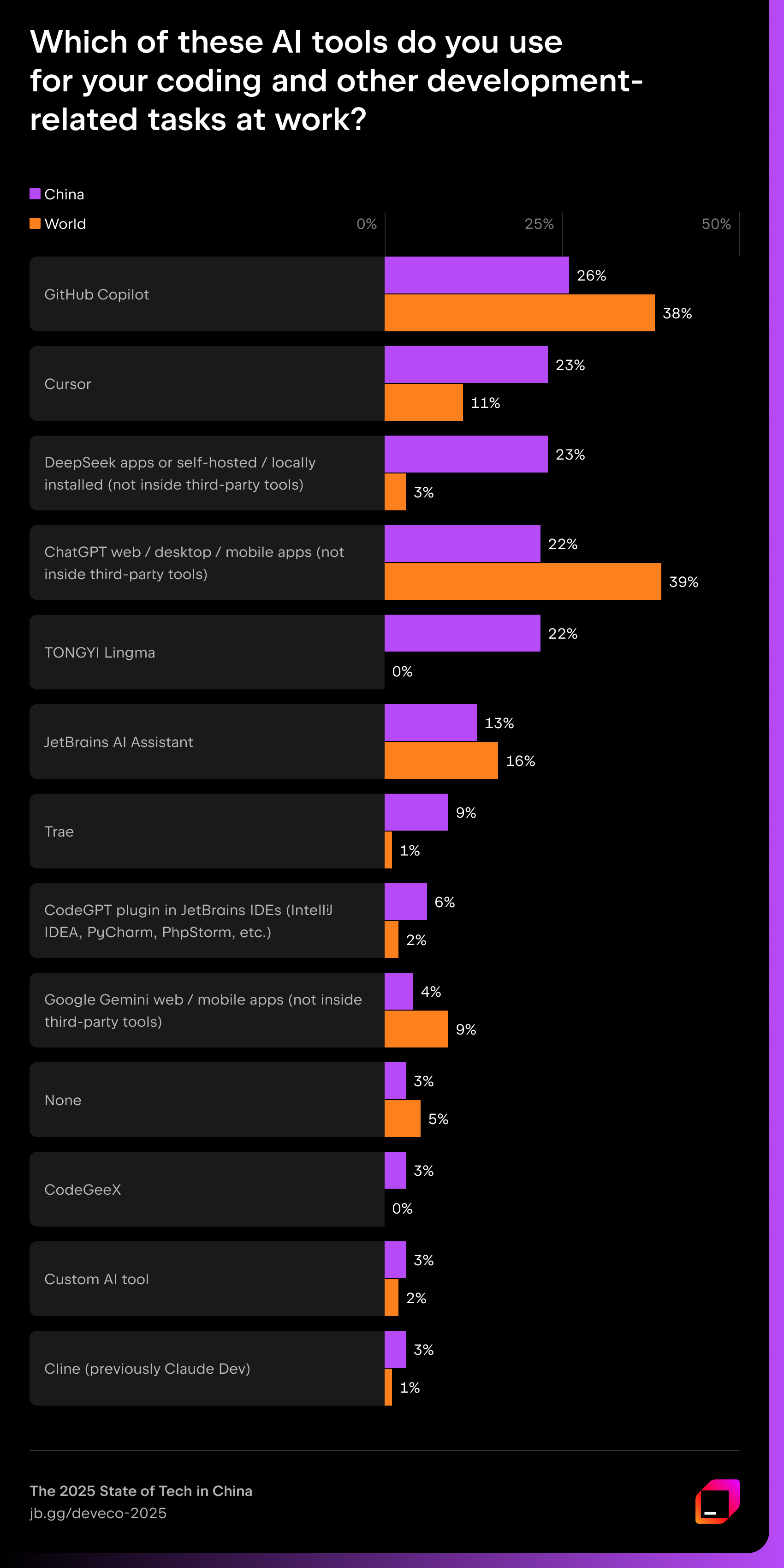
- GitHub Copilot 在中国的普及率显著低于全球(26% vs. 38%)。
- Cursor 展现了惊人的增长势头,23% 的中国开发者正在使用它,而全球仅为 11%。
- ChatGPT 和 Claude 等全球领跑者在中国的渗透率较低。取而代之的是,DeepSeek (深度求索) 和 通义灵码 (TONGYI Lingma) 等本土替代方案扮演了重要角色,反映出市场对国产或自托管解决方案的强烈偏好。
Note: 注:由于问卷中列出的 LLM 选项有限且未设开放式填空,上述发现仅反映问卷所涵盖工具的使用情况,而非全市场的完整图景。
写在最后
本文所分享的洞察,比我们在公开图表中展示的内容更为深入(公开图表通常不包含此类地域对比过滤器)。
我们很高兴能与大家分享关于中国开发者生态系统的深度视角,并特别感谢每一位参与调研的开发者——正是你们的贡献,让我们得以捕捉并理解这些独特的趋势。
如果您希望参与未来的研究,帮助我们了解全球开发者的工作方式,诚挚邀请您加入 JetBrains Tech Insights Lab。
本博文英文原作者:


Subscribe to JetBrains Research blog updates
Discover more







Insights Into China’s Developer Landscape: Key Trends From the JetBrains Developer Ecosystem Survey 2025
Every year, thousands of developers take part in the JetBrains Developer Ecosystem Survey, helping us map the evolving landscape of software development worldwide. Published in eight languages with data from 20 geographical regions, the survey includes China – a fast-evolving market that shares many global characteristics while retaining distinct traits of its own.
For example, Java remains the most widely used language in many Chinese industries – a pattern that differs from global trends and reflects the country’s vast mobile and enterprise sectors. At the same time, rising adoption of Go and TypeScript points to a growing focus on scalability, developer experience, and modern web architectures.
Thanks to the contributions of our survey participants, we’re able to offer a closer look at the Chinese developer ecosystem, including insights not featured in our published infographics. We hope these findings are valuable not only to developers working in China, but also to those less familiar with the market who may find it fascinating to compare local practices with global trends.
Software development trends in China: It’s all in the details
Broadly, the coding landscape in China looks similar to that of many other regions: STEM graduates with backgrounds in computer science, trained in widely adopted languages and tools, applying their skills in various industries. But to understand what truly shapes this market, it’s vital to look beneath the surface – and that’s where the differences emerge.
1. The prevalence of Java for coding
While Java remains a popular development language worldwide, it is far more common among Chinese developers than in most other regions.
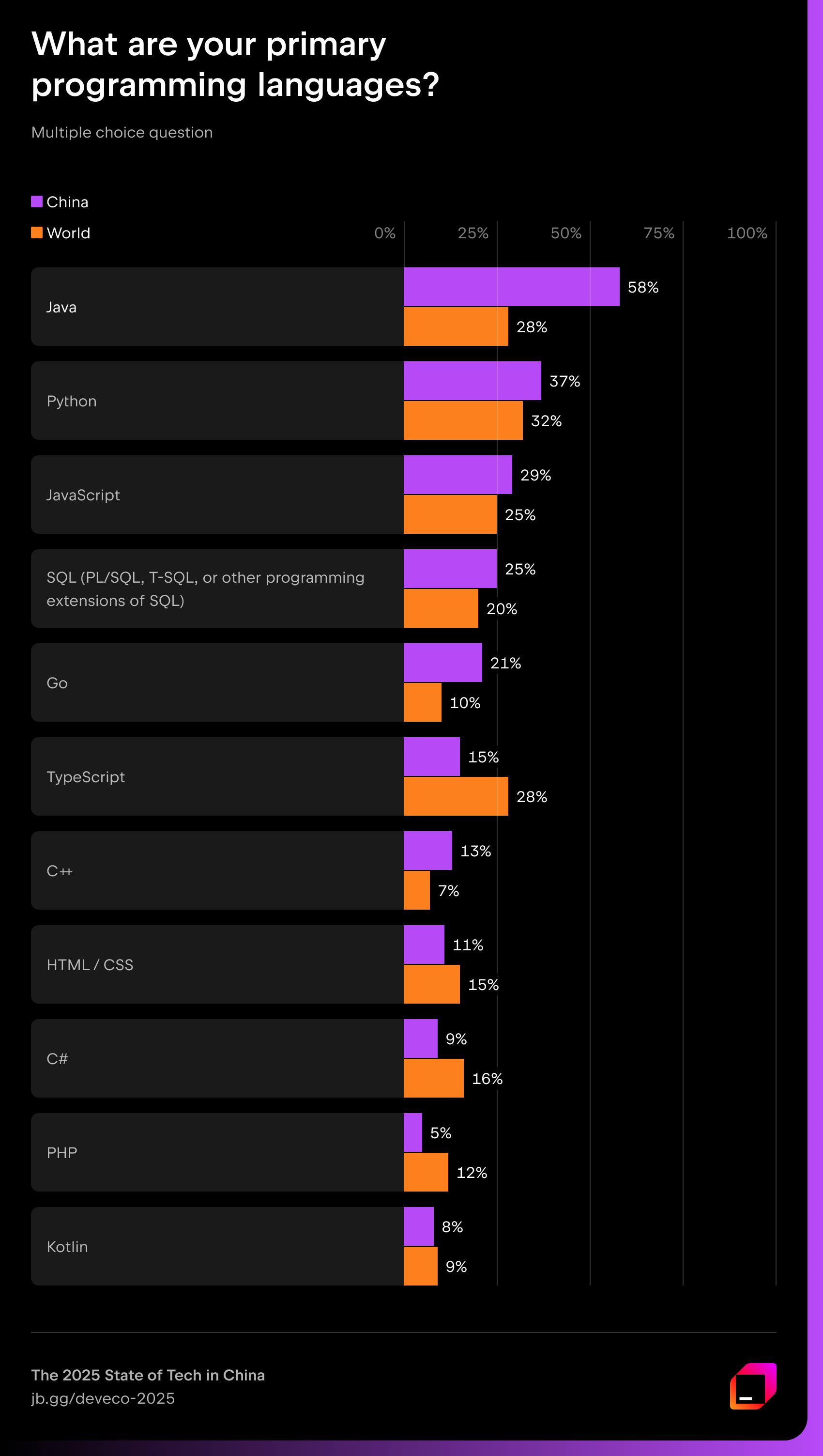
Globally, 28% of professional developers use Java as their primary development language, with Java, JavaScript, and Python forming a relatively balanced “big three”. In China, however, Java stands out clearly: it’s the first choice of 60% of Chinese developers.
“The dominance of Java in the Chinese market is fundamentally driven by the explosive growth of its internet industry and the resulting established technology stacks. China’s massive wave of e-commerce, fintech, and social media startups standardized on Java in their early stages. They built their core, high-throughput, distributed systems on proven Java frameworks like Spring and Apache Dubbo. This created a massive ecosystem and a self-reinforcing cycle: Companies use Java because the talent pool is large, and developers learn Java because that’s where the jobs are.
There’s also the Android factor. Before Kotlin became the preferred language, the massive adoption of Android smartphones in China cemented Java’s position for years as the primary language for mobile app development, further expanding its developer base.”
2. Widespread mini-app adoption vs. limited cloud service development in China
In Developer Ecosystem 2025, Chinese developers show a significantly higher tendency to develop mini-apps compared to the global developer community: nearly a quarter of professional developers in China are involved in mini-app development. The two most popular solutions are uni-app (31%) and Weixin native (25%), though around 20% of developers report dissatisfaction with the current tooling ecosystem.
Mini-apps (小程序) are deeply integrated into daily life in China. A single mobile app can host a wide range of services, from messaging and taxi booking to food delivery and business registration. These lightweight applications run inside larger platforms and typically rely on platform-specific frameworks, such as WeChat Mini Programs and uni-app, combining JavaScript, custom markup languages, and CSS-like styles.
This year, the WebStorm team introduced a highly requested WeChat Mini Program plugin for working with Weixin native, with support from user research. This plugin adds native support for WXML, WXSS, and WXS syntax, allowing developers to work directly in WebStorm without switching between the WeChat IDE and their primary editor. It also reduces time spent checking component documentation. More details about the WeChat Mini Program plugin are available in this blog post.
3. Publicly traded companies outweigh privately owned ones
Our third theme looks at where developers work and the types of organizations they are part of. The chart displays a diverse mix of company types, highlighting how the distribution in China differs from the global picture.
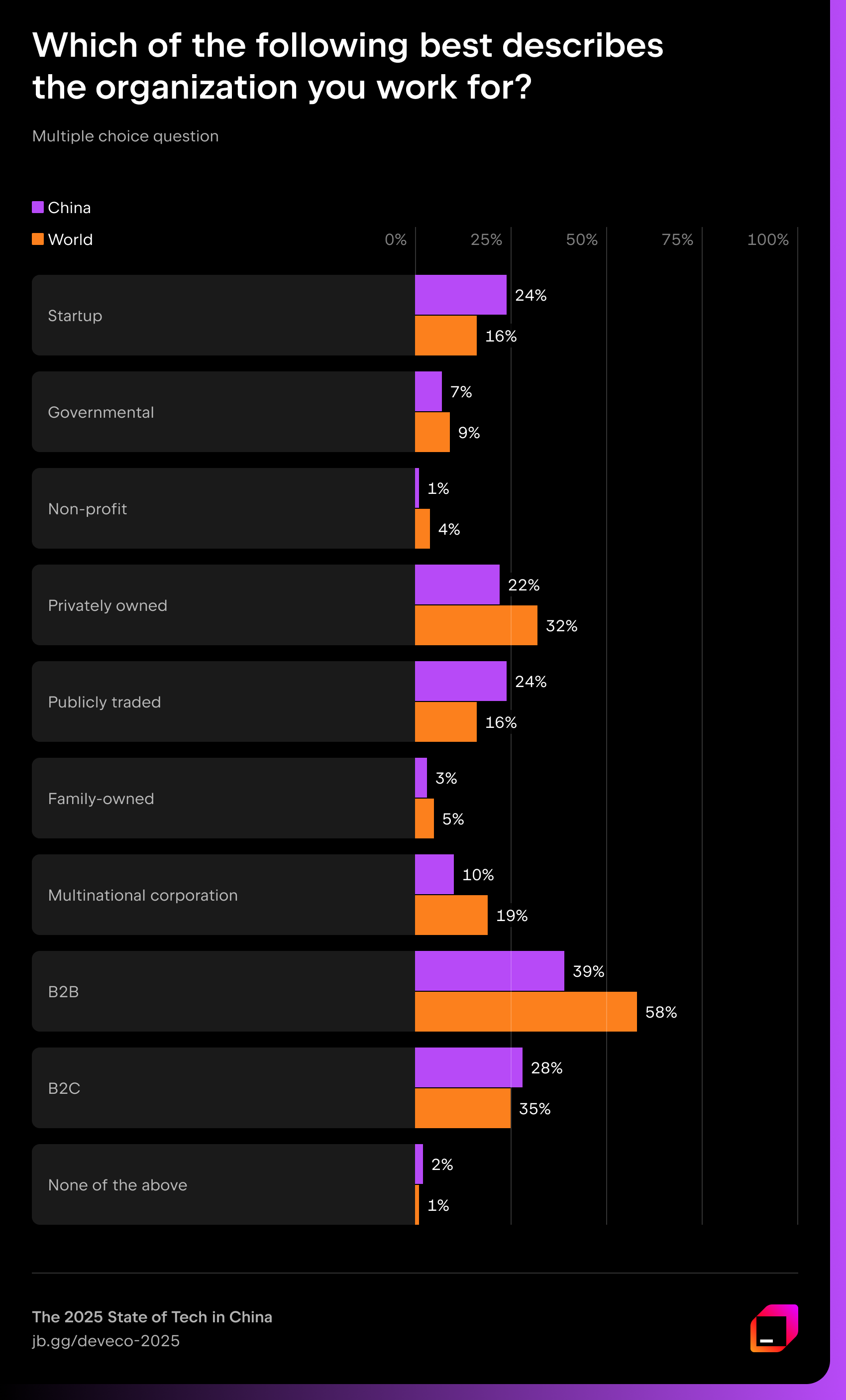
- Privately owned companies: Chinese respondents are more likely to work for startups (23%) and large publicly traded companies (24%), compared to the global averages of 17% and 16%, respectively. The more striking difference, however, lies in ownership structure – only 23% of Chinese developers work for private companies, compared to 32% worldwide.
- Multinational corporations: Just 9% of developers in China are employed by multinationals, far below the global average of 19%.
- B2B vs. B2C: Business orientation also differs. In China, 39% of developers work in B2B and 27% in B2C, compared to 57% in B2B and 35% in B2C globally. This suggests a stronger consumer-facing focus in the Chinese market, where developers more often contribute to end-user products and services.
4. A perspective on low-code / no-code
Chinese developers show a stronger tendency to actively engage with low-code/no-code platforms compared to the global average.
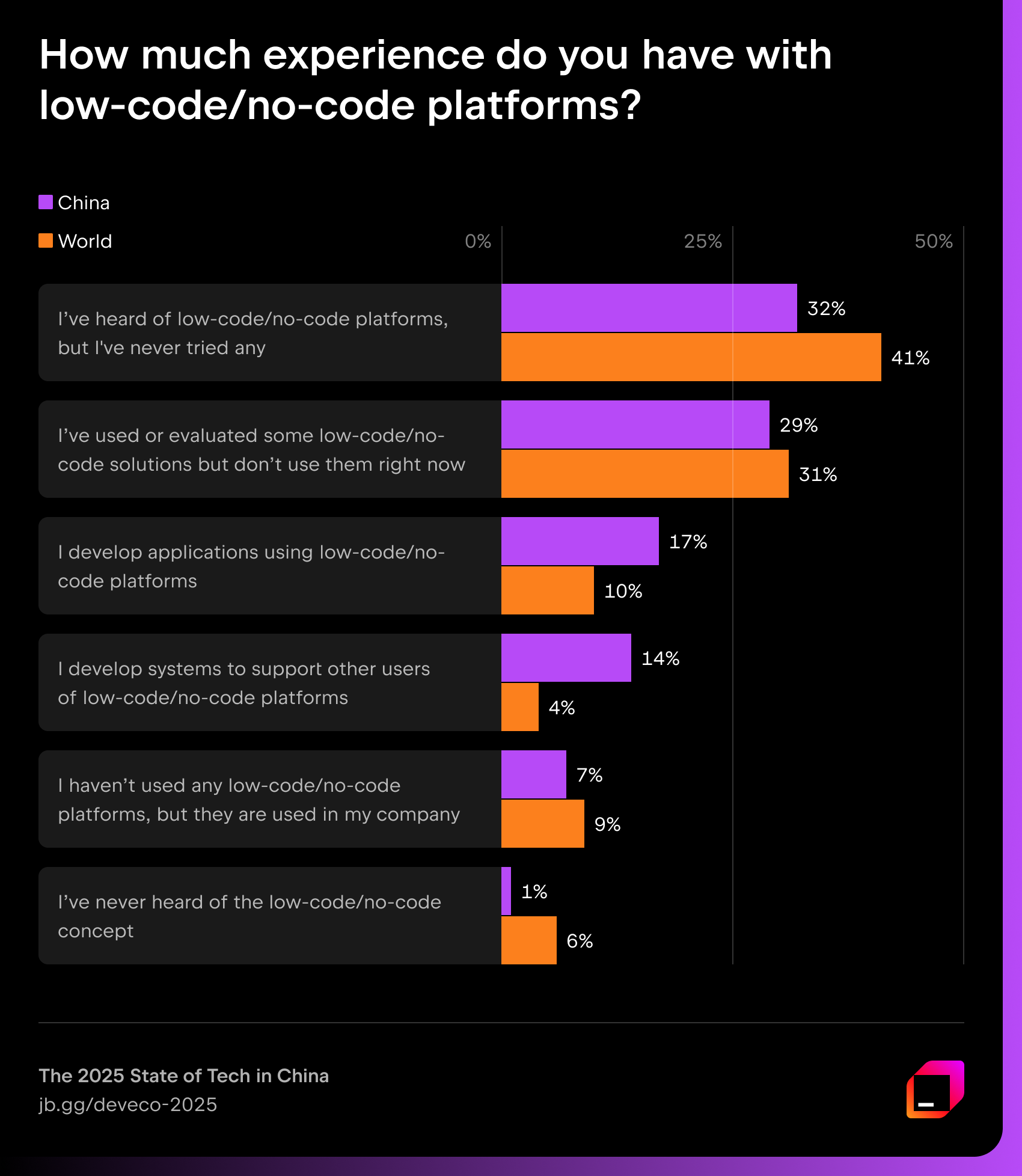
Chinese developers are more likely to build applications using these tools (17% vs. 9% globally). Business process automation (BPA) remains the top use case worldwide and in China.
The gap appears in building websites and applications: 24% of Chinese respondents use low-code/no-code for building websites and applications, compared to just 17% globally.

Globally, low-code/no-code is still viewed primarily as a tool for business processes and rapid prototyping. In China, however, it has become part of a broader productivity-driven culture, with developers not only using these tools themselves but also enabling others to build and automate through them.
5. Chinese LLM landscape: Foreign LLMs remain the top choice
Chinese developers show a distinct pattern in their use of AI tools. GitHub Copilot is significantly less popular in China than worldwide (24% vs. 34%), while Cursor has gained remarkable traction and is used by 25% of Chinese developers compared to 12% globally.
Global leaders like ChatGPT and Claude are also far less represented in China. Instead, local alternatives, such as DeepSeek and TONGYI Lingma, play a major role, reflecting a strong preference for domestic or self-hosted solutions.
Note: The list of LLMs in the survey was limited, with no open field. As a result, the findings reflect only the tools included in the questionnaire rather than the full market landscape.
Closing thoughts
The insights in this post go beyond what you’ll find in our public infographics, which do not include comparison filters. We’re glad to share these deeper perspectives into the Chinese developer ecosystem, and we’re especially grateful to everyone who took part in our survey – your contributions make it possible for us to capture and understand these unique trends.
If you’d like to take part in future studies and help us learn more about how developers work around the world, we invite you to join the JetBrains Tech Insights Lab.
To stay updated on new findings, stories, and behind-the-scenes perspectives, subscribe to the JetBrains Research Blog.