JetBrains Research
Research is crucial for progress and innovation, which is why at JetBrains we are passionate about both scientific and market research
Which AI Coding Tools Do Developers Actually Use at Work?

The reality beyond the hype, featuring evidence from large-scale, globally representative developer surveys.
If you’re like us, you can’t open your LinkedIn or X feed without there being some mention of an AI coding agent (Claude Code, Codex, Gemini CLI, Junie, and others). But which of these AI tools are actually used for development at work, not just for pet projects?
This post answers that question, drawing on insights from a series of surveys on AI coding tools awareness, adoption, and satisfaction. As the industry moves toward more complex, agentic workflows, understanding which tools are gaining professional traction is essential for building the future of development infrastructure.
We regularly run large-scale, globally representative developer surveys to get up-to-date data on the developer tools landscape. In January 2026, we ran the second wave of our AI Pulse survey, a large-scale survey localized into eight languages with a sample size of over 10,000 professional developers worldwide. Our goal was to capture the latest trends in the AI developer tools market.
We are now ready to share how AI coding tools like Claude Code, Cursor, JetBrains AI Assistant, Junie, GitHub Copilot, OpenAI Codex, and Google Antigravity have evolved over the past two years in terms of awareness, adoption, and satisfaction. The data is based on the September 2025 and January 2026 AI Pulse surveys, as well as the 2024 and 2025 waves of the JetBrains Developer Ecosystem Survey, which is well-known in the community.
The biggest question is not whether developers use AI at work. The answer to that is already obvious: They do. In January 2026, 90% of developers regularly used at least one AI tool at work for coding and development tasks, a clear sign of high AI usage in software development.
However, developers’ toolkits are changing rapidly nowadays, leading to a more intriguing question: Which tools are being adopted for actual work, and at what rate? By January 2026, 74% of developers worldwide had already adopted specialized AI tools for developers (e.g. AI coding assistants, editors, and agents; not just chatbots like ChatGPT).
Performance over platform: The rise of best-of-breed agents
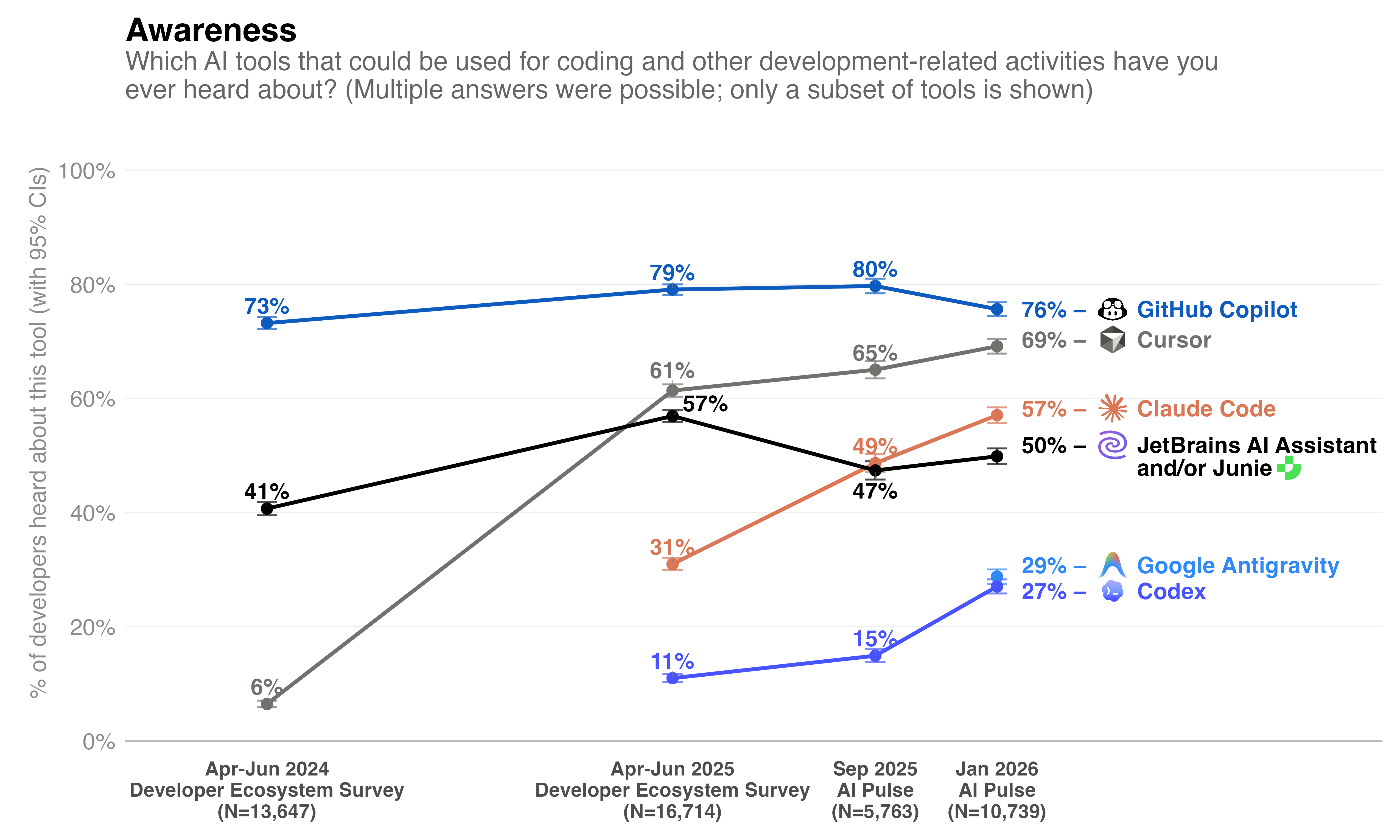
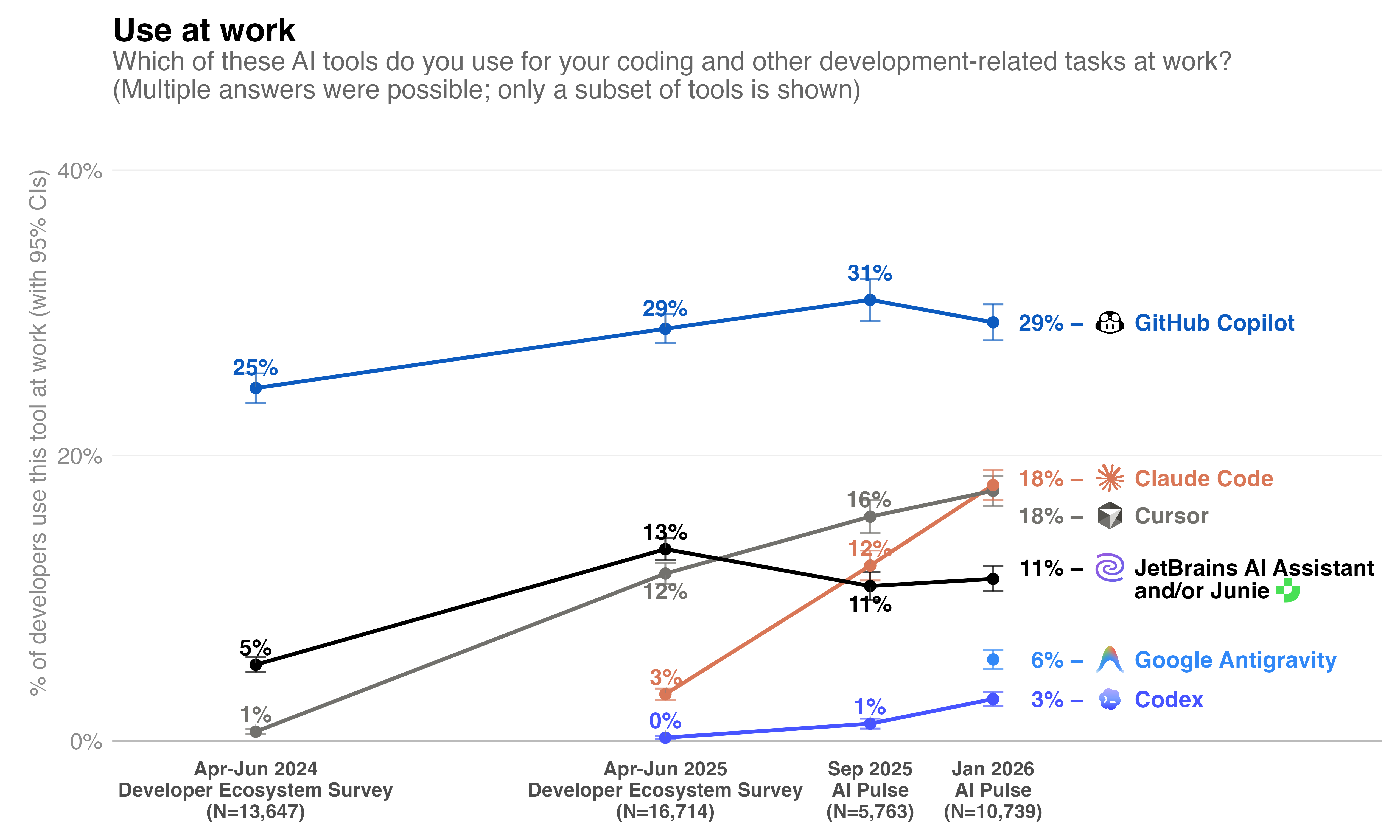
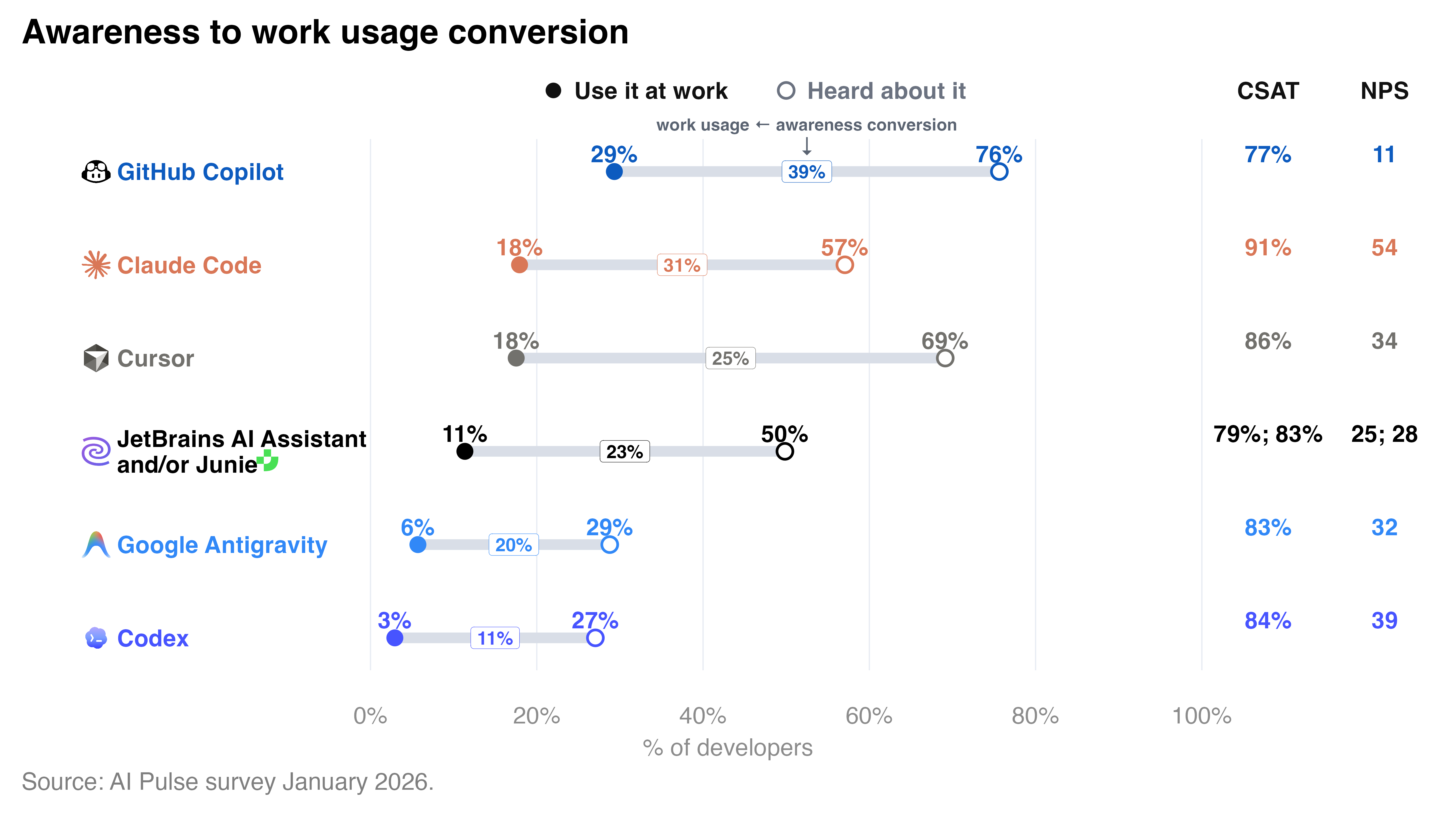
GitHub Copilot is still the most widely known and adopted AI coding tool, with 76% of developers worldwide having heard about it and 29% using it at work. However, its growth, both in terms of awareness and adoption, has stalled since last year. Despite that, it is still popular in companies with over 5,000 employees, where it is adopted by 40% of developers.
Cursor’s growth has slowed down, both in terms of awareness and adoption at work. It is still the second most well-known AI dev tool, with 69% of developers aware of it. However, in terms of adoption at work, it now shares second place with Claude Code, with both being used for work by 18% of developers worldwide.
Claude Code is continuing to rapidly grow in awareness, adoption, and admiration. 57% of developers had heard of it in January 2026, compared to 49% in September 2025 and 31% in April–June 2025, and 18% currently use it at work, a 1.5x increase from September 2025 and 6x increase from roughly 3% in April–June 2025. In the US and Canada, its adoption even reached 24% in January 2026. It also has the highest product loyalty metrics on the market, with a CSAT (satisfaction) of 91% and an NPS (likelihood to recommend) of 54 (on a scale from -100 to +100).
The shift toward best-of-breed agents demonstrates that product excellence now outweighs ecosystem lock-in. When a standalone tool offers clear superiority, it renders integrated stacks obsolete; developers will always migrate to the individual components that actually deliver the best results.
As of January 2026, OpenAI’s coding agent Codex was much less popular and known in the developer community. 27% of developers worldwide had heard of it, and only 3% were using it for work. It is worth noting that this number comes from the data collected before the public launch of the Codex desktop app and its promo in ChatGPT, which is still being used extensively by developers for coding and development-related tasks at work (28%).
Google Antigravity is the new kid on the block. The AI code editor launched by Google in November immediately gained traction, reaching an adoption rate of 6% by January 2026.
Chatbot interfaces are still quite popular among developers, with 28% of developers using the ChatGPT chatbot for coding and development tasks at work, 8% using Gemini, and 7% using Claude’s chatbot.
Our move toward an open agentic infrastructure
11% of developers worldwide use JetBrains AI Assistant and/or Junie, with JetBrains AI Assistant being regularly used by 9% of developers and Junie by 5%.
At JetBrains, we believe the future of development is an open ecosystem where developers have the freedom to choose the best agents for their specific tasks. This vision informs our own direction:
- JetBrains IDEs: Claude Agent and OpenAI Codex are integrated in the AI chat of JetBrains IDEs, while dozens of other coding agents, including Cursor, can be accessed through the Agent Client Protocol. You can even use Codex via your OpenAI API key or ChatGPT subscription.
- JetBrains Central: Much more than a simple integration, Central serves as a unified control and execution plane for agent-driven software production. It transforms discrete AI tasks into a manageable system by providing governance, cloud-based agent runtimes, and a shared semantic layer that gives agents a system-level understanding of your code organization. Developers are able to initiate and manage agent workflows from the tools they already use – JetBrains IDEs, third-party IDEs, CLI tools, web interfaces, or other solutions through integrations. Agents can come from JetBrains or external ecosystems, including Claude Agent, Codex, Gemini CLI, or custom-built solutions.
- Air (Public Preview): A dedicated agentic development environment, Air lets you delegate coding tasks to multiple agents – including Claude Agent, Codex, Gemini, and Junie – and run them concurrently. While traditional IDEs add tools to the code editor, Air is built from the ground up to orchestrate agents, allowing them to operate in isolated Docker containers or Git worktrees. This ensures that agents have a deep structural understanding of your codebase (including symbols, commits, and methods) without interfering with your main working copy. Air supports the Agent Client Protocol and offers total flexibility: You can use a JetBrains AI subscription or Bring Your Own Key for providers like OpenAI and Google.
- Junie CLI (Beta): Junie CLI has entered Beta as a lightweight, LLM-agnostic coding agent that brings the power of agentic development directly to the terminal. Unlike tools tied to a specific ecosystem, Junie allows you to switch between models (such as OpenAI, Anthropic, Google, and Grok) using a Bring Your Own Key approach. It is designed to be a “local-first” agent, running tasks in your local environment with deep awareness of your project’s structure. This makes it an essential tool for developers who prioritize model independence and command-line speed.
We’ll continue tracking how the AI dev tools landscape evolves, especially regarding the use of AI coding agents and related adoption challenges at the organizational level. We will cover this topic in the forthcoming Developer Ecosystem Survey 2026, which will launch in April with results to follow soon thereafter. Stay tuned!
Some methodological notes for curious minds and fellow researchers:
In this report, when we use the term “developers”, we mean respondents who reported having any of the following job roles: Developer / Programmer / SWE, AI / ML Engineer, DevOps Engineer / Infrastructure Developer, Architect, Data Scientist / Engineer / Analyst, or QA Engineers involved in coding or programming. Roughly 90% of the sample falls into the Developer / Programmer / SWE job category.
The AI Pulse survey was localized into eight languages: English, Spanish, Chinese, Japanese, Korean, German, French, and Portuguese.
The survey was promoted via Instagram ads targeting developers and coding professionals. In China, we used a local media platform – Zhihu. We also collected a small portion of the sample via our JetBrains research panel (accounting for roughly 16% of the responses).
There was no mention of AI in the survey promo or description, as we wanted to avoid skewing the sample by attracting more AI enthusiasts or skeptics. Instead, the survey was positioned as being about tools that developers use for their work.
The campaign was largely debranded, meaning there was no mention of JetBrains in the ad banners or on the survey starting page. However, the survey was still promoted via JetBrains social media accounts.
There were quotas on the required number of responses by region to achieve accurate global representation. The quotas were proportionate to the number of developers in each region, based on estimates by our Data Science team. The detailed methodology of these estimates is described here.
We applied raking weighting to align our sample data with the distribution of key variables observed in the Developer Ecosystem Survey 2025. We weighted the data along three dimensions:
- Number of developers by region
- Coding experience
- Familiarity with JetBrains products
The methodology of Developer Ecosystem Surveys is described here.