
Popular Go Web Frameworks: A Practical Guide for Developers

According to the 2025 Go Developer Survey, 46% of Go developers use the language to build websites and/or web services. It’s therefore unsurprising that the topic of web frameworks frequently pops up in conversation and is often the subject of healthy debate.
The GoLand team enters the chat armed with data to answer the question: What are the most popular web frameworks for Go developers and why?
Do I even need a framework?
Developers from environments that rely heavily on frameworks, such as JavaScript, will naturally seek out frameworks to simplify or reduce their workload. Meanwhile, hardcore Gophers will reject external libraries and frameworks altogether as superfluous dependencies that ultimately make their work harder. Both sides are right to some extent; using Go’s standard library exclusively comes with its own set of pros and cons.
Reasons to use net/http
- Robustness: Go famously has a “batteries included” approach, and the
net/httppackage is no exception. Go’s standard library provides a solid foundation for building web services; in particular, it already includes routing, middleware composition via handlers, and an HTTP server implementation. - Simplicity: The standard HTTP package has no extra frills or dependencies. This means developers often write more boilerplate, but it also provides clear and predictable building blocks that can be composed however a project requires.
- No dependencies: Some developers prefer to exclusively use
net/http, so as to avoid external dependencies. Third-party libraries are only good as long as they’re maintained, and they can always introduce security risks and maintenance overhead. Especially in larger commercial projects, these limitations are often unacceptable. - Full control: Developers who stick with
net/httphave full control over their code and don’t have to pay the “overhead tax” for features they don’t use that come with the libraries. - Maintenance and growth: Go is regularly maintained by the Google team, and new features are added consistently, such as enhanced routing patterns in 1.22.
- Standardization: Since every Go developer knows
net/http(or so we hope), in commercial settings, this eliminates the need to learn new tools to become productive when a new developer is hired.
Reasons not to use net/http
- Lack of built-in abstractions: It’s not that the standard library can’t handle complex scenarios; it’s that it can quickly turn into a nightmare for the engineer who has to provide instructions on how to handle them. Many developers turn to external libraries for the convenience they provide when it comes to routing or middleware management.
- Productivity loss: As is often the case with Go, using standard solutions equals writing a lot of boilerplate code to stitch things together, which forces developers to work on mundane tasks, negatively affecting their productivity.
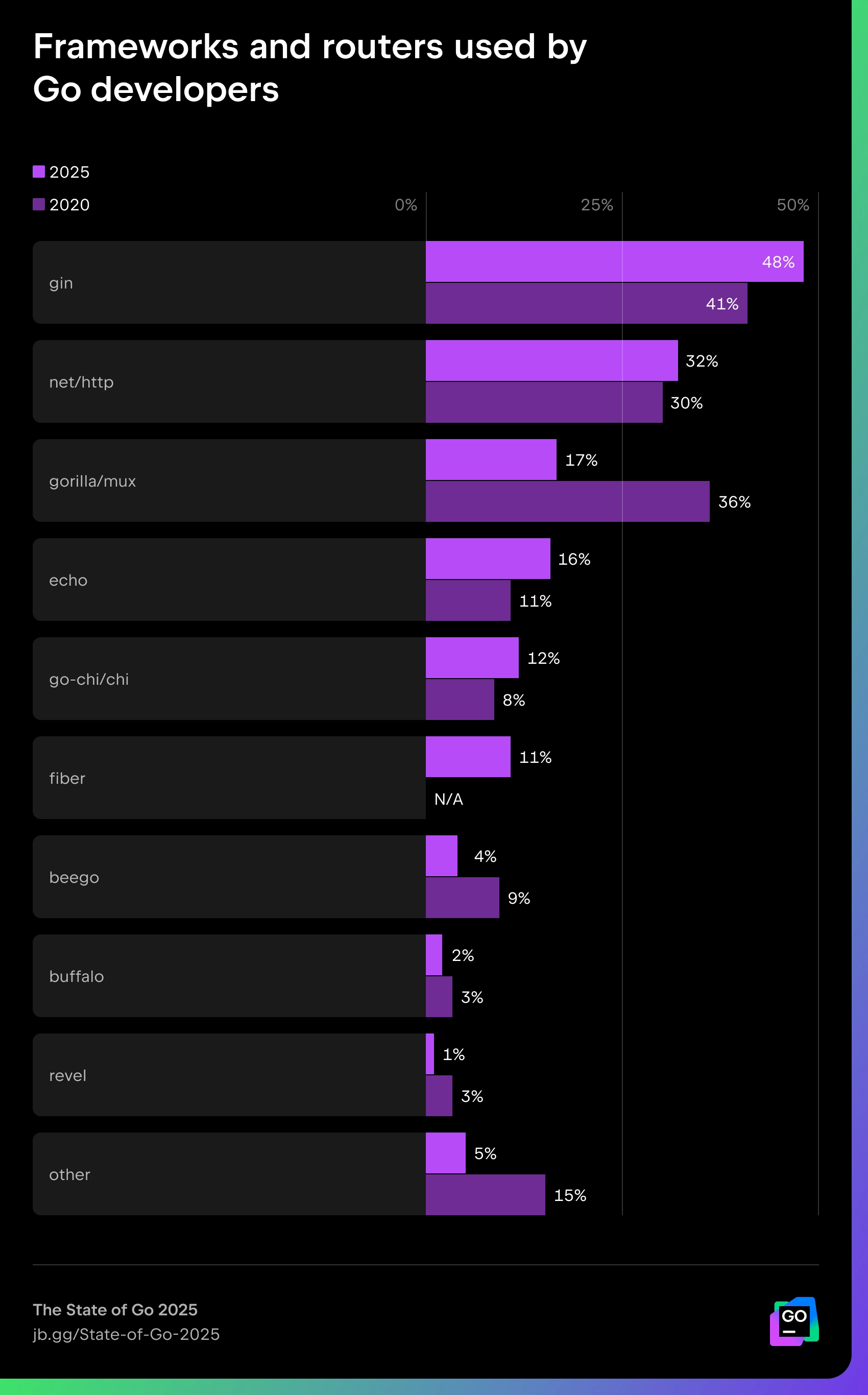
Whether you are convinced by the arguments for or against, the truth remains that – according to JetBrains State of Developer Ecosystem Report 2025 – as much as 32% of Go developers use net/http, and its popularity remains largely unchanged.
Most popular Go web frameworks
Unlike a lot of other languages – as is the case with Ruby and Rails or Python with Django or Flask – there isn’t one dominant framework that every Go developer would recognize and use. While stdlib remains a popular choice, our data shows that it has a formidable opponent, used by almost half of Go developers – Gin.
On top of that, in our analysis of The Go Ecosystem in 2025, we’ve identified the most widely used web frameworks to be Gin (48%), Gorilla (17%), Echo (16%), and Fiber (11%).
Now, let’s look at how they stack up against each other and against net/http and see if there is a clear winner when it comes to web frameworks for Go (spoiler alert: There isn’t ?).
Gin
Gin is an HTTP web framework for building REST APIs, web applications, and microservices in Go. It offers middleware support, JSON validation, route grouping, error management, and built-in rendering. Gin is highly extensible and remains the top choice for Go developers as one of the fastest regularly maintained frameworks with a developer-friendly API. It has over 88,000 stars on GitHub and a sizable community around it, so you can expect to find a lot of examples and support from other developers when you run into trouble.
You can create a router engine in Gin with (gin.Default()) or without (gin.New()) middleware attached, depending on how much control you need. gin.Default() comes with logger and recovery middleware out of the box. Other middleware lives in the official gin-contrib collection, where you can find a CORS mechanism, as well as authentication, session manager, pprof, and other tools.
Gin’s creators boast that its “performance [is] up to 40 times faster than Martini”, though in 2026, this probably doesn’t indicate much. Thankfully, they also run their own benchmarks, allowing you to compare Gin’s performance against a number of more modern libraries as well. And while Gin is not the most performant in all scenarios (Aero actually takes that cake), the results are still very close to the top across the board. This is largely due to zero-allocation routing, which keeps the app memory usage stable even under high traffic.
Gin is an opinionated framework, which means it follows its own approach. For example, it uses gin.Context instead of the standard context.Context. It is still built on top of net/http, but if your code depends heavily on Gin-specific features, moving to another framework later may require extra work.
Pick Gin if you want a framework that:
- Is familiar to most developers and thus easier to adopt.
- Has community support and lots of learning resources, making onboarding and troubleshooting easier.
- Provides simple, widely adopted patterns for easier development.
Echo
Echo is yet another high-performing and minimalist framework that has an HTTP router without dynamic memory allocation. It includes automatic TLS, support for HTTP/2, middleware, data binding and rendering, and various template engines. It’s also very extensible at various levels. It continues to grow in popularity, with 16% of Go developers declaring its use in 2025.
Echo has a broad catalog of official middleware that you will also find in other frameworks, such as CORS, JWT, and key authentication tools, as well as a logger and rate limiter.
Similarly to Gin, Echo is built on top of net/http, but it does deviate from it at times. For example, it uses Echo.context instead of context.Context. Also, Echo handlers use the signature func(echo.Context) error rather than http.HandlerFunc, but Echo provides adapters to integrate standard net/http handlers when needed.
Choose Echo if you:
- Care about clean, centralized error handling and handlers that return errors.
- Need a more structured, “batteries-included” framework.
Chi
Chi also claims to be a lightweight yet robust composable router for building Go HTTP services. Some would argue it’s not really a framework, but it’s still quite popular with Go developers, ranking as the fifth most popular alternative (used by 12% of developers in 2025).
Chi’s authors claim it offers “an elegant and comfortable design” for large REST APIs, and the framework itself is deconstructed into smaller parts. You can use the standalone core router or extend it with subpackages for middleware, rendering, and/or docgen. Other key features include full compatibility with net/http and no external dependencies. Chi uses standard Go handler types and middleware shape.
This means that Chi is compatible with all standard middleware, giving you more flexibility. Its optional middleware package includes a suite of core net/http tools, and on top of that, there are also extra middleware and other packages. Some noteworthy middleware options include: CORS, JWT auth, request logger, and rate limiter tools.
You can check Chi’s benchmarks here, though they are rather old.
It’s worth considering Chi if:
- You want to stay close to the standard library: Some would argue there’s no point in even using Chi because you can achieve the same thing with
net/http. If, however, you feel that a router would make your life easier, but you still want full compatibility withstdlib, Chi might be the choice for you. - You want more of a router than a full framework.
Fiber
Finally, there’s Fiber – a framework that JavaScript developers in particular will be very fond of, as it’s inspired by Express. It boasts robust routing, the ability to serve static files, API-readiness, a rate limiter, flexible middleware support, low memory footprint, support for template engines and WebSocket, and – you guessed it! – great performance. The Fiber team provides its own benchmarks here. It’s the last framework that’s been adopted by over 10% of developers according to our survey.
What differentiates Fiber from the other frameworks we’ve already discussed is that it’s built on a different HTTP engine – fasthttp. It can interoperate with net/http; however, the compatibility is provided through adapters and not through shared foundations. As Fiber’s architecture is fundamentally different from the standard library, choosing it locks you in more than other frameworks do, and migrating between Fiber and net/http frameworks typically requires more refactoring.
Considering Fiber’s architecture, it’s no surprise that it offers the broadest built-in toolbox of all the frameworks discussed. On top of that, it also has a whole host of third-party middleware maintained by the Fiber team or the community. Some of the most popular middleware options for Fiber are: a template engine, adaptor that converts net/http handlers to Fiber handlers and vice versa, Helmet integration, and key authentication tools.
Fiber is especially good for:
- Developers with experience using Express.js: JavaScript developers who used Express before will feel right at home with Fiber because of the similarities.
- Projects where performance is really crucial, even at the expense of idiomatic Go.
(Honorable mention) Gorilla
Strictly speaking, Gorilla is not a full-blown framework but rather a toolkit, and Gorilla/mux is just a router. But we include it on the list due to its enduring presence, with 17% of developers still using it in 2025. Even with a sharp decline in popularity compared to 2020, it’s still the third most popular choice (after Gin and net/http), despite the project no longer being actively maintained by the original team (the last update was in November 2023). While community forks continue development, most new projects today veer towards alternatives, such as Chi, or the improved routing features in Go’s standard library.
So how do they stack up?
net/http | Gin | Echo | Chi | Fiber | |
| HTTP engine | stdlib | net/http | net/http | net/http | fasthttp |
Compatibility with net/http | Native | Partial | Partial | Full | Via an adapter |
| Maintenance | Core Go | Active | Active | Active | Active |
| Performance | High | Very high | High | High | Extremely high |
| Learning curve | Low | Low | Medium | Very low | Medium |
| Standout features | No dependencies; standardized solution | Wide adoption; robust community support | Clean error handling; “batteries-included” approach | Closeness to stdlib; minimalist features | Similarity to Express; extremely high performance |
| Dependencies | None | Moderate | Moderate | Very low | Significant |
| Extensibility | Very high | Moderate – sometimes requires adaptation | Moderate – requires wrapping | Very high | Low – mostly incompatible with standard middleware |
| Ecosystem | The largest and most mature; supported by Google | Very mature with the largest community and adoption after net/http | Mature with a strong community and long-term maintenance | Mature with a sizeable community | Younger framework, with a community that’s still expanding |
Compatibility with net/http | Native | Opinionated, but built on net/http | Built on top of net/http | Designed around net/http – fully compatible | Not directly compatible, built on fasthttp |
Code samples
To show you how each framework handles API ergonomics, how verbose it is, and how it deviates from idiomatic Go, here’s a sample of the same API endpoint implemented in different frameworks.
net/http
// net/http
http.HandleFunc("/users", func(w http.ResponseWriter, r *http.Request) {
    json.NewEncoder(w).Encode(users)
})
Gin
// Gin
router.GET("/users", func(c *gin.Context) {
    c.JSON(200, users)
})
Echo
// Echo
e.GET("/users", func(c echo.Context) error {
    return c.JSON(200, users)
})
Chi
// Chi
r.Get("/users", func(w http.ResponseWriter, r *http.Request) {
    json.NewEncoder(w).Encode(users)
})
Fiber
// Fiber
app.Get("/users", func(c *fiber.Ctx) error {
    return c.JSON(users)
})
How can GoLand help web developers?
Using frameworks is not the only thing that can make your life easier; your IDE can help you stay productive as well, without locking you in. Here’s how using GoLand can help you as a web developer.
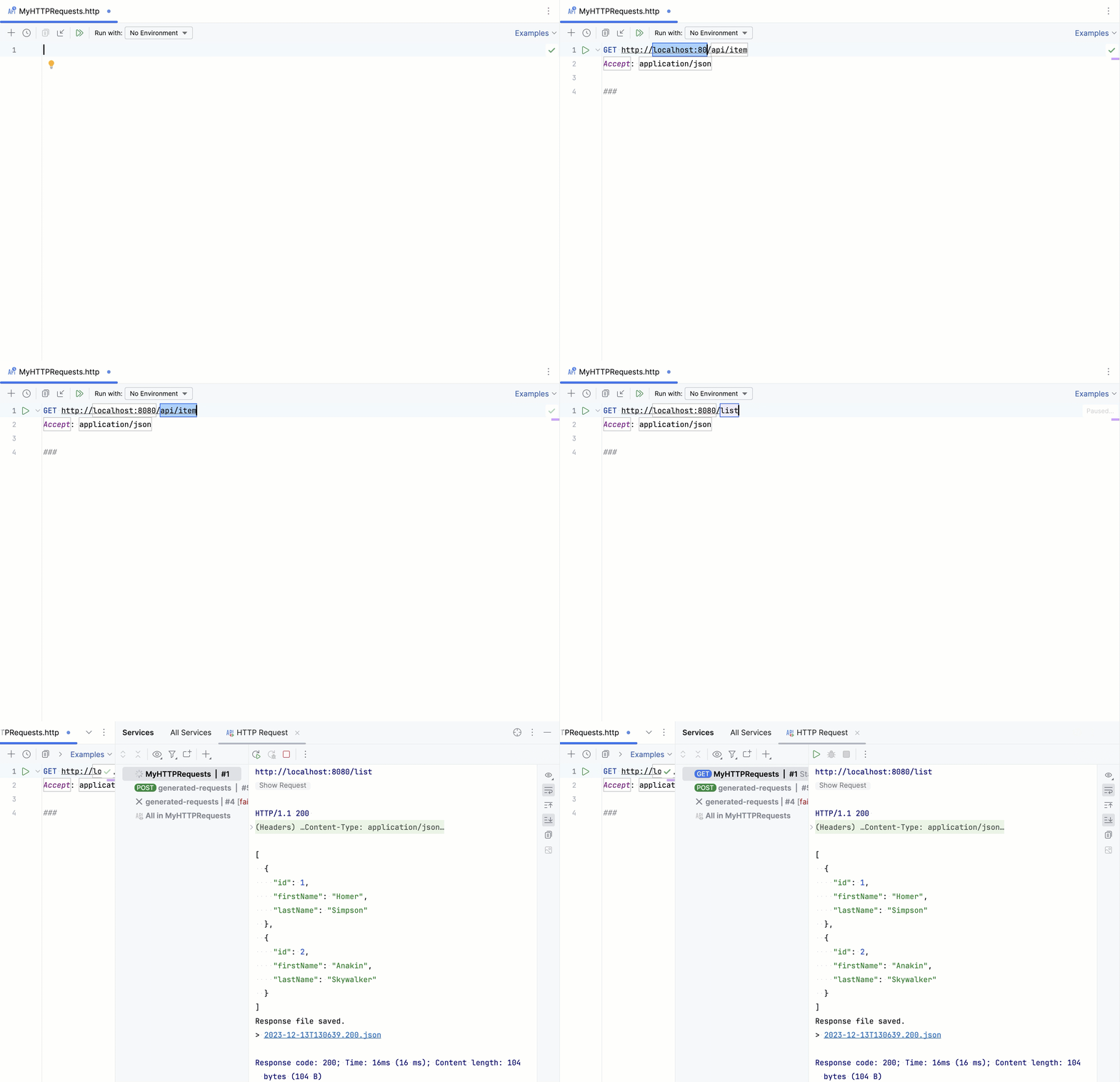
- HTTP Client: With the HTTP Client plugin, you can create, edit, and execute HTTP requests directly in the GoLand code editor. This is especially useful when you are developing a RESTful web service or an application that interacts with one. This tool includes features like code highlighting, completion, folding, live templates, and language injections.
- Endpoints tool: This window provides an aggregated view of client and server API used in your project for HTTP and WebSocket protocols. It can help you when you’re developing microservices, backend-frontend communication, and when you need to explore third-party APIs.
Frequently asked questions
What is the difference between Go’s standard library and a web framework?
Like in any other language, libraries are there to provide solutions to common problems and free up your time to focus on important work. While Go’s standard library, and net/http in particular, contain everything you need to build a production-ready web server, the libraries described in this article will help you avoid a lot of boilerplate and simplify common tasks such as routing, middleware composition, and request binding.
Why doesn’t Go have a single dominant web framework?
In the Go ecosystem, frameworks are optional rather than foundational. Many production services are built directly on top of net/http, while others use lightweight routers or frameworks to simplify common tasks.
Because the standard library is so robust, for many engineers, there isn’t really a good justification for using frameworks that require learning their syntax, create extra dependencies, and force regular updates. There isn’t a single dominant framework because none of them is superior to stdlib; they just offer different tradeoffs.
Are Go web frameworks necessary for production applications? Is net/http sufficient for building scalable APIs?
One of Go’s key differentiators is that, technically, you don’t need any external libraries for your application. Go’s standard library has everything you need, regardless of the scale of your project, and some hard-core Gophers stick to only that.
This is not to say that libraries are bad or useless – if they make your life easier and you’re aware of the tradeoffs, there’s really no reason not to use them.
What should I consider when choosing between Gin, Echo, Fiber, and Chi? Is one of them better for APIs or microservices?
While most Go web frameworks support common features such as routing, middleware, and JSON handling, they differ in architecture, ecosystem compatibility, and how closely they follow net/http. When deciding on the right one for you, focus primarily on what your team and project need.
- If you’re looking for an established solution with a solid knowledge base that’s familiar to everyone, consider Gin.
- If you need a more structured framework with centralized error handling, go for Echo.
- If you’re after a lightweight router and need full compatibility with
net/http, Chi is your best bet. - If you’re familiar with Express.js or you need extreme performance, even at the cost of compatibility, think about Fiber.
Does using Fiber limit compatibility with the Go ecosystem?
To a certain extent – yes, at least more than the other frameworks mentioned in this article. Because Fiber was designed around fasthttp, it had to make architectural trade-offs.
The biggest limitation is that you cannot use the vast library of generic Go middleware with Fiber out of the box. You therefore need to use middleware maintained by the Fiber team or employ an adapter (adaptor.FromHTTP), which introduces performance overhead and effectively defeats the reason to use Fiber in the first place.