JetBrains AI
Supercharge your tools with AI-powered features inside many JetBrains products
Bring your own AI agent to JetBrains IDEs

Hey!
Here at JetBrains, we’re always happy to bring our users the best and most popular tools available on the market. This has been true for decades with conventional dev tooling: compilers, debuggers, build tools, etc; in the past several years, we’ve shipped all the newest LLMs in the same manner, and we want the same to happen for AI agents. That’s why this fall we started working on the Agent Client Protocol (ACP). Today, I’m excited to show a beta version of its support in the latest release-candidate versions of our IDEs.
What is ACP?
The Agent Client Protocol standardizes communication between code IDEs and coding agents, much like LSP did for language servers. Users can choose any agent in the IDE they love, agent developers focus on core features instead of integrations, and IDE authors get new capabilities faster.
We believe that a common standard between coding agents and editors is actually a very natural point of separation. Humans and AI are working together in the same environment solving the same problems, so it makes sense for both parties to speak a shared language. Editor vendors and AI-agent developers have different strengths and areas of expertise, and a common standard helps them meet in the middle without getting in each other’s way. Such a protocol provides the core foundation, makes access predictable and streamlining the distribution, that lets everyone move faster.
Demo
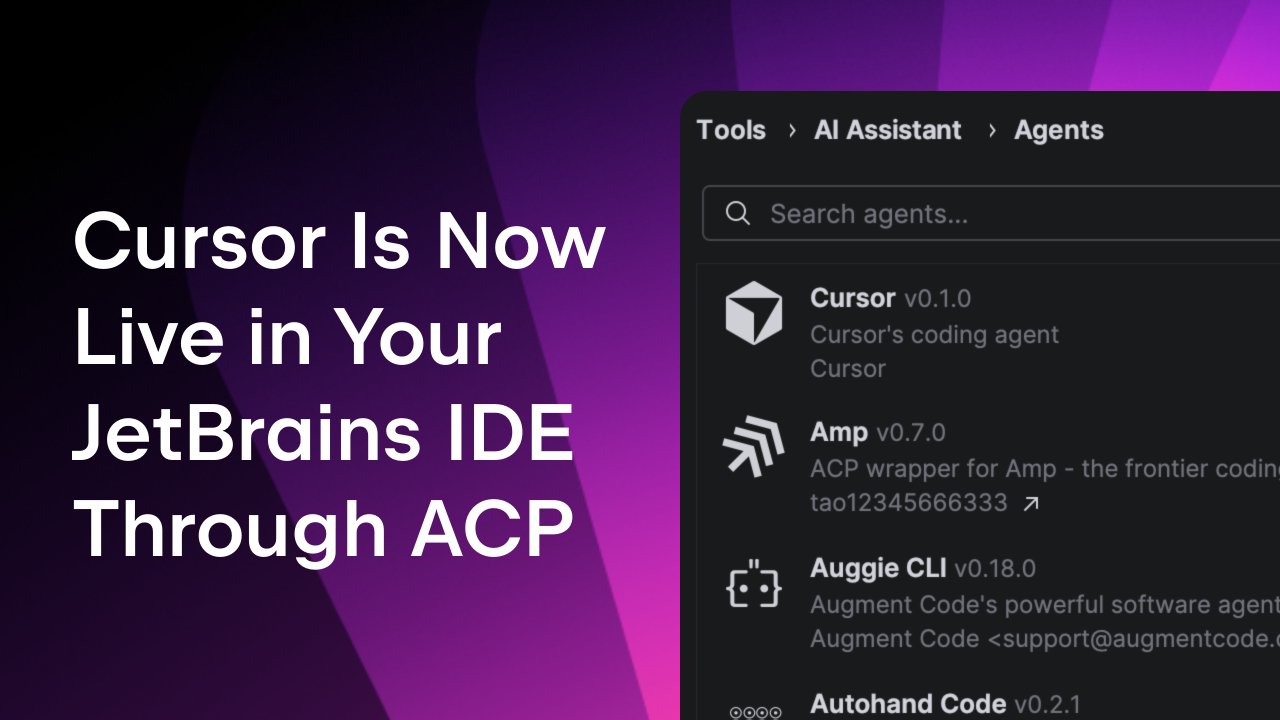
The latest 25.3 release candidate brings the betas ACP support to our unified AI chat. Feel free to use any ACP-compatible agent of your choice in our IDEs. While we’re in beta, we assume that you’ve already logged in to your CLI agent before adding it to the IDE. After that, you just need to adjust a configuration file and you’re good to go.
Read the documentation to learn more about ACP in our IDEs.
Current status
We’re shipping the beta version of ACP support in our IDEs and we’ll be happy to hear your feedback. If you’re an agent developer, feel free to join our community and share your ideas about the protocol. We hope to see more agents in our list.
Note: AI Chat currently requires you to register and verify your account. We are working to simplify this flow. Within about a month, you should be able to access ACP agents with an option to skip JetBrains AI registration.
What’s next?
Here are the key directions we’re focusing on next. First, regarding the product’s UX: while applying standards, we are trading off some tailor-made features, and we want to bring some of them back into the protocol. Second, we are beginning work on agent distribution and aim to build a curated registry of ACP-capable agents. Third, we want to reuse the same standard for agents running on remote servers, not only on the local machine. And finally, we want to offer the MCP toolchain we have in IDEs, thereby improving the agents themselves.
Behind the closed doors
Before we wrap up, I want to share a bit of behind-the-scenes context on how JetBrains came to ACP. Real life is a bit different, and I think it’s always nice to pull back the curtain and show you how it works from the inside. So, here we go.
This summer we started working on bringing Junie (it’s a coding agent developed by JetBrains) into the same UI that we had for the AI chat. After some debates, we built a protocol that allowed us to communicate between IDE and local and remote versions of Junie. We were about to publish that work to the internet, but almost at the same time, Zed announced its own protocol. We chatted with lovely Zed people and agreed that instead of bringing two competitive standards to the market, we’d join our efforts on building a single one.
And so far we are really happy with our choice. From the user perspective, we see plenty of ACP-capable agents now and more to come. Technically, the protocol is easy to implement while providing powerful and flexible UX in the product. From a business standpoint, we now have good relationships with multiple partners. And not the least, personally, I’m really happy to work together with passionate people, it’s always encouraging.
What our partners are saying
“Developers should be able to use the best AI agent in the workflow that suits them, and ACP makes that possible. Setup was easy and Auggie just works, exactly what every developer wants. ACP is a win for developer choice and a big step toward a more open, agent-driven ecosystem.”
– Chris Kelly, Product, Augment Code
“In AI coding agents, openness will win when developers can choose the tools that work best for them instead of being locked into a single vendor’s ecosystem. That’s why open protocols like ACP matter. Personally, I have been using PyCharm for over a decade, and at Block we have long been part of the JetBrains community through our Kotlin adoption and ecosystem contributions. ACP lets goose integrate into IntelliJ seamlessly. Developers can bring their own LLM and log in directly without extra authorization overhead. When open source tools like goose and ACP work together, developers get the freedom to choose, and we get to focus on making our agent smarter instead of maintaining IDE-specific code.”
– Douwe Osinga, goose Open Source Lead, Block
“At Zed, we believe the best things are built together. Collaborating with JetBrains on ACP has felt like we were one team from day one. Driven by a shared commitment to deliver the best experience for our users, we’ve made it possible for developers to use the agents they know and love in their favorite editor. This release brings ACP to an entirely new audience, and I’m excited to see the response as we shape the roadmap together.”
– Ben Brandt, Rust Engineer, Zed Industries
“At Moonshot AI, we’ve always believed that the future of coding agents belongs to developers, not vendors. By integrating with JetBrains via the open ACP protocol, Kimi CLI can now run natively in the IDEs that hundreds of millions of developers already love and trust. No lock-in, no extra authentication dance, no compromise on model choice. This is exactly the kind of open, composable agent ecosystem we want to see win.”
— Richard Chien, Kimi CLI Maintainer, Moonshot AI
Thanks
None of this would have been possible without lots of people. Special thanks to Alexey Stukalov, Anna Zhdan, Artem Bukhonov, Ben Brandt, Denis Shiryaev, Franciska Dethlefsen, Stas Erokhin, and all others for their contributions. It’s been a nice journey, and I hope it’s only the beginning.