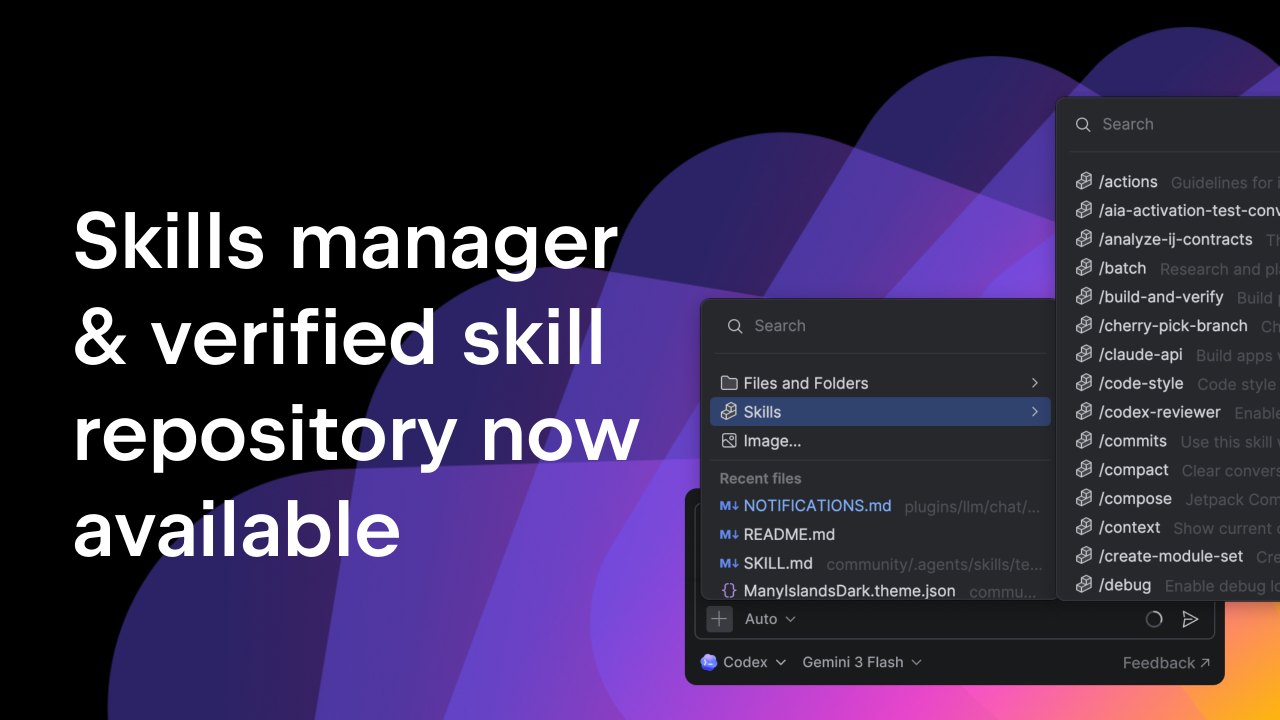
Supercharge your tools with AI-powered features inside many JetBrains products

The control and execution plane for agent-driven software production.
Most enterprises claim to govern their AI use. They have policy documents, review boards, approval flows, and sandbox environments. On paper, control exists. Then agents enter real software delivery workflows.
Build reliable AI agents natively on the JVM. Koog for Java provides idiomatic builders, persistence, and observability – no Python microservices required.
Easily track LLM usage, tool calls, and application flow in your AI-powered Kotlin projects. Add OpenTelemetry-backed observability with minimal code changes.
Meaningful AI performance measurement is not about bigger numbers or more dashboards. It is about connecting operational signals with business truth.
As we approach the midpoint of the decade, game developers face an evolving landscape shaped by shifting job security, technology choices, platform strategies, and practical AI adoption. Our State of Game Development 2025 report reveals critical insights that provide a clearer picture of where the industry is heading.
Every untested component and ill-specified feature becomes louder when AI enters the mix.
In online learning environments, tasks can often stump students, which can be challenging to navigate since teachers can’t always be there to help. Our Education Research team develops innovative features for education tools and recently built a smart AI-based hints tool that provides personalized feedback for students who might need help solving tasks. This AI tool goes beyond the automated hints common in massive open online courses (MOOCs) and delivers tailored, effective guidance that helps students move forward.