Introducing JetBrains Central: An Open System for Agentic Software Development

AI is beginning to change how software is produced. Instead of just assisting developers inside the editor, AI agents now investigate issues, generate code, run tests, and execute multi-step workflows. As this work scales, software development extends beyond individual tools or sessions. It becomes a distributed system of agents, environments, and workflows that operate across IDEs, CLIs, pipelines, and collaboration tools.
In this new model, code generation is cheap and no longer a bottleneck. The real challenge is aligning outcomes with intent, along with managing the growing operational and economic complexity of agent-driven work. Without control over these factors, systems become harder to reason about, scale, and sustain.
This shift is happening quickly. Of the 11,000 developers worldwide who responded to the January 2026 JetBrains AI Pulse survey, 90% already use AI at work. Adoption of coding agents is also accelerating – 22% of developers already use AI coding agents, and 66% of all companies surveyed plan to adopt them within the next 12 months.
However, most of AI’s impact remains limited to individual productivity. No more than 13% of developers report using AI across the entire software development lifecycle, such as for code review or in the release pipeline, and organizations struggle to translate AI use into measurable improvements in software delivery speed, system reliability, or cost efficiency.
JetBrains Central: The control and execution plane for agent-driven software production
JetBrains Central transforms discrete AI-powered workflows into a unified production system. It connects tools, agents, and infrastructure, allowing automated work to run, be monitored, and be managed across teams – with clear visibility into results, costs, and performance.
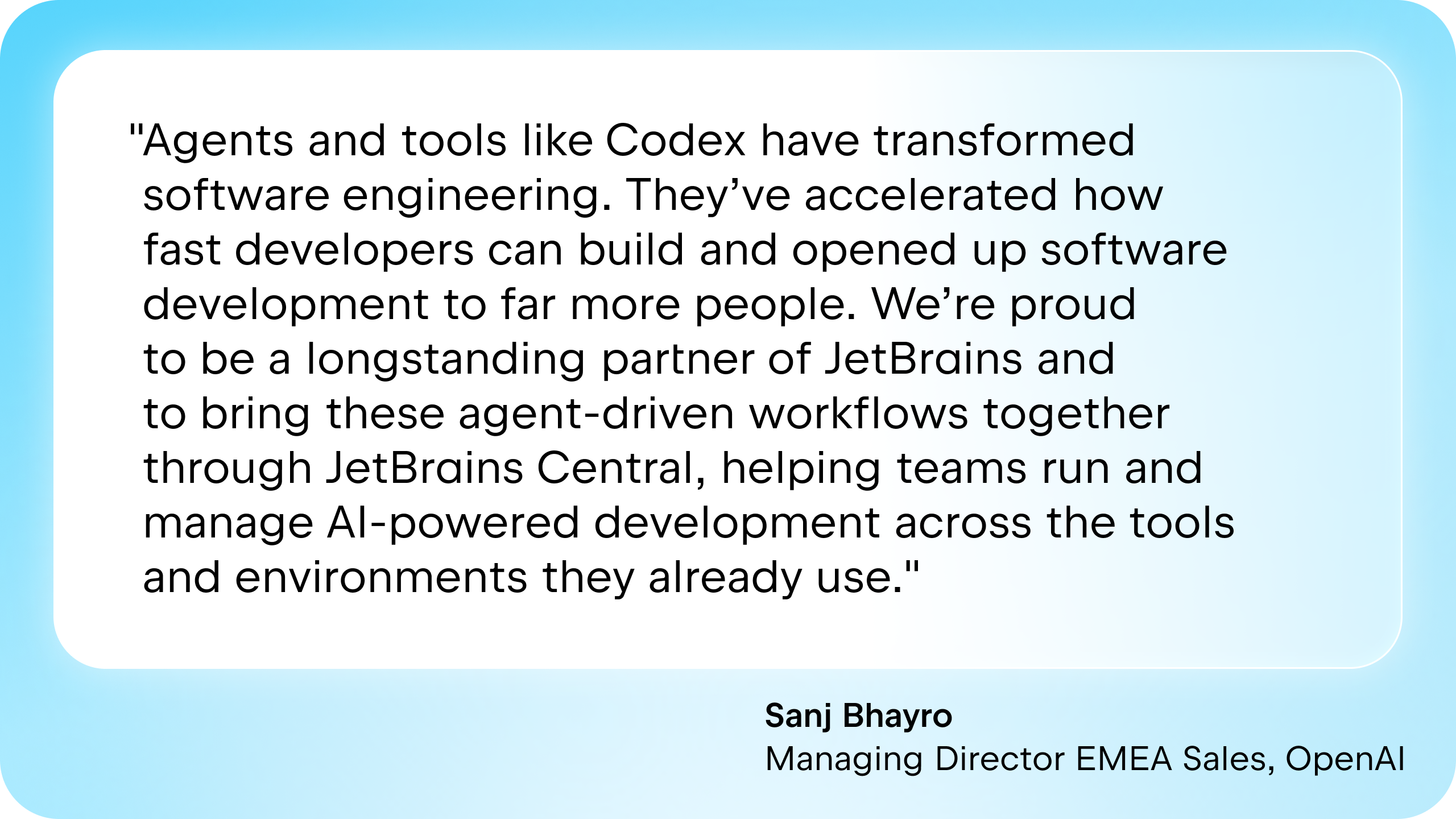
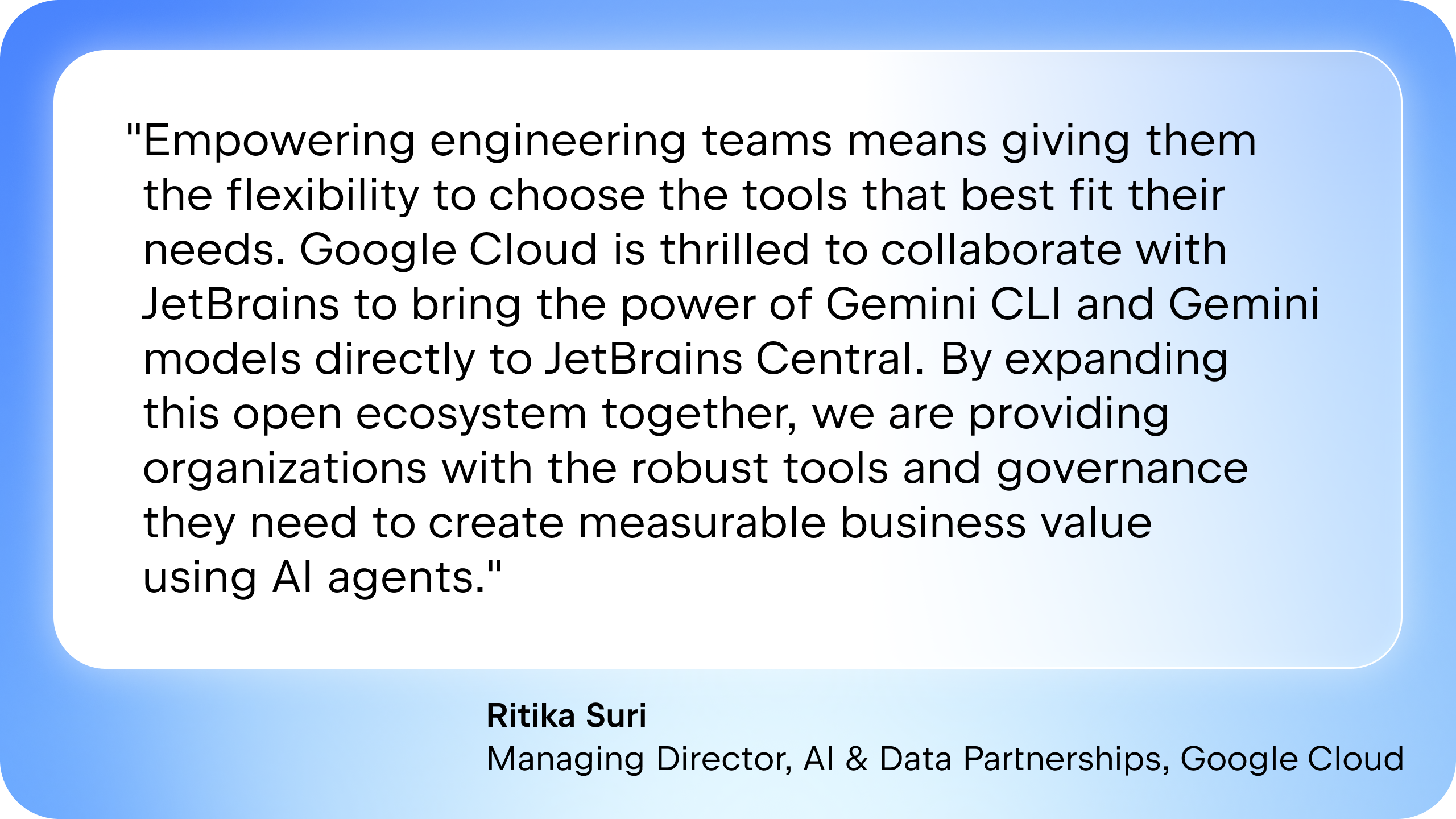
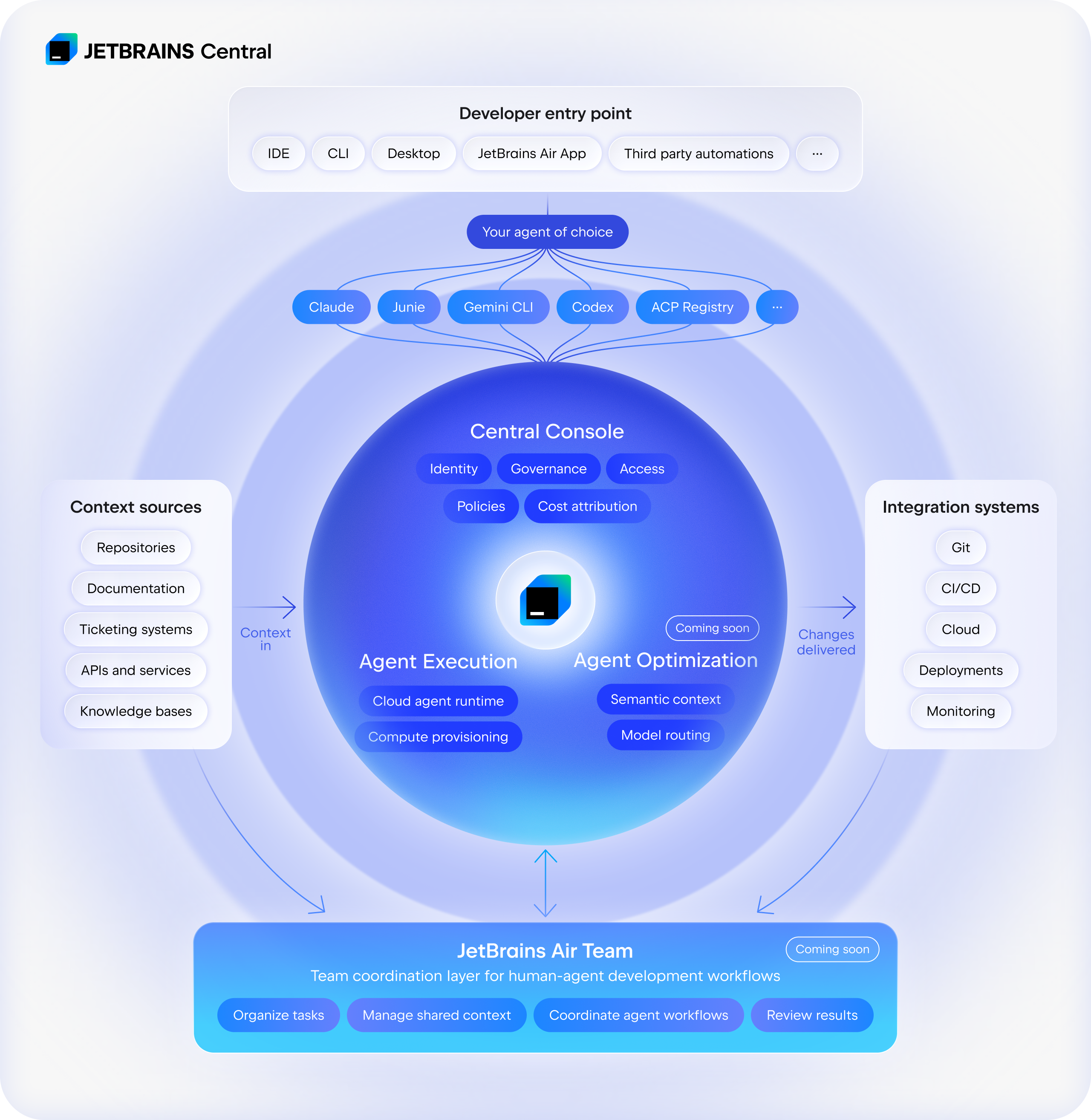
Developers can initiate and manage agent workflows from the tools they already use – JetBrains IDEs, third-party IDEs, CLI tools, web interfaces, or integrations. Agents can come from JetBrains or external ecosystems, including Claude Agent, Codex, Gemini CLI, or custom-built solutions.
JetBrains Central provides three core capabilities:
- Governance and control
Policy enforcement, identity and access management, observability, auditability, and cost attribution for agent-driven work. Some of these functionalities are already available via the JetBrains Central Console.
- Agent execution infrastructure
Cloud agent runtimes and computation provisioning that allow agents to run reliably across development environments.
- Agent optimization and context
Shared semantic context across repositories and projects, enabling agents to access relevant knowledge, and task routing to the most appropriate models or tools.
JetBrains Central is not a monolithic platform. Instead, it functions as a layered system that connects developer tools, AI agents, and development infrastructure.
This architecture enables a no-lock-in approach to AI-driven development, allowing organizations to integrate new tools and models while preserving and extending the systems they have already invested in. This eliminates the need for costly replatforming.
Context, semantics, and integrations across the software delivery system
To be effective, AI agents must operate within real software production systems and organizational contexts – not in isolation.
JetBrains Central connects agents directly to the systems where software is built and run, including repositories, knowledge bases, delivery pipelines, and infrastructure. This allows agents to execute work within existing development workflows, rather than in separate AI environments.
At the core of this system, we are building a semantic layer that continuously aggregates and structures information from code, architecture, runtime behavior, and organizational knowledge. This enables agents to move beyond prompt-level interactions and operate with a system-level understanding of how software is designed, how it behaves in production, and what outcomes are expected.
On top of this foundation, JetBrains Central provides intelligent routing and task optimization, selecting the most appropriate models, tools, and execution paths for different tasks.
Agents collaborate with human teammates through the tools teams already use – such as Slack, Atlassian products, or Linear – ensuring that agent-driven workflows remain integrated into existing development systems instead of becoming isolated AI workflows.
Coordinating human and agent workflows with JetBrains Air
The recently launched Air App provides a dedicated workspace where developers can organize tasks, run agent-assisted workflows, and review results while staying close to their development environments.
For teams, JetBrains is developing Air Team – a space for coordinating work between humans and agents, enabling teams to organize tasks, run multi-step workflows, and stay aligned as work happens across systems. It builds on JetBrains Central and brings these capabilities into everyday team workflows.
The foundation for an AI-native software production system
JetBrains Central is designed to help individuals, teams, and organizations embrace the shift happening in software development.
Individual developers are free to use the tools and agents they prefer. Agents can assist with complex engineering tasks while developers remain in control of the development process and outcomes.
Engineering teams can coordinate work between humans and AI agents in a structured way. They can organize tasks, share context, and run multi-step agent workflows that accelerate development while keeping work transparent and reviewable.
Organizations gain centralized visibility and control over AI-driven development. JetBrains Central provides governance across teams and tools, including policy enforcement, security controls, auditability, and cost management.
By integrating these layers into a unified production system, it ensures that AI-driven work can be scaled predictably across the entire enterprise.
“We’re increasingly leaning into agents and AI-driven workflows, which is creating a need for better visibility into costs and governance. That’s why we’ve started piloting JetBrains Central internally. It’s an evolving process, but it reflects how we build at JetBrains: by using our own products to better understand and shape them.”

Availability and design partners
The Early Access Program will launch in Q2 2026 with a limited group of design partners to test JetBrains Central in real-world agentic workflows. Organizations interested in participating as design partners can apply to join the Early Access Program.
As JetBrains Central evolves, teams will be able to scale AI usage up or down, shift capacity across teams, and align spending flexibly according to their changing development priorities. To support this flexibility, we will soon introduce updated JetBrains AI pricing for organizations.
JetBrains Central is our step toward an open, AI-native system for software production, where humans and agents collaborate throughout the full lifecycle to get to market faster and deliver measurable outcome improvements.
AI will not replace software development, but AI is already redefining it as a system. Our goal is to ensure that this system remains controllable, reliable, and aligned with real business outcomes.