
Rust vs C++: Competition or Evolution in Systems Programming for 2026


C and C++ are the backbone of modern software. Operating systems, databases, game engines, and compilers all trace their roots to these languages. They give developers low-level control over memory, hardware, and performance. It’s a level of control that has defined decades of software development. However, the landscape has shifted, and the Rust vs. C++ conversation has become central to how teams approach modern systems programming.
For a long time, choosing C++ was straightforward. It offered speed, power, and reliability. But today, developers have one more option: Rust. Rust keeps many of the benefits of C++ while addressing some of its most persistent challenges, including memory safety, undefined behavior, and concurrency issues. It also comes with a modern, integrated toolchain that can make development smoother and less error-prone.
Since its 2010 debut, Rust has evolved from a niche project to a serious contender for systems programming. Its design enforces safety at compile time through concepts like ownership, borrowing, and lifetimes. Developers can write high-performance code without risking memory leaks or undefined behavior.
TLDR: C++ and Rust are both high-performance systems programming languages with different strengths. C++ is mature and flexible, offering low-level control and a vast ecosystem, while Rust emphasizes memory safety, concurrency, and modern tooling. Benchmarks show comparable performance, but Rust reduces runtime bugs through compile-time checks, whereas C++ relies on programmer discipline. Both languages are complementary, and the best choice depends on project needs, legacy requirements, and priorities for safety or control.
Rust’s philosophy: safety and speed
Rust’s design is deliberate. Every value has a single owner. Passing it to a function either transfers ownership or borrows it temporarily. The compiler checks these rules at compile time.
This system prevents memory leaks, dangling pointers, and data races before the program even runs. Rust allows unsafe code, but it must be clearly marked.
In short, Rust gives developers control without the common pitfalls of C++. It is safe by default and fast by design. C++ can offer similar power, but its safety relies heavily on the experience and discipline of the programmer.
Head-to-head: C++ versus Rust performance
Look at most benchmarking tests, and there’s a common theme: in a Rust vs C++ battle, Rust will win a few measures, but C++ will win by a few more. (Albeit by a small margin, typically sub-10%.) What matters here is that pure performance scores don’t tell the whole story. But first, some sources.
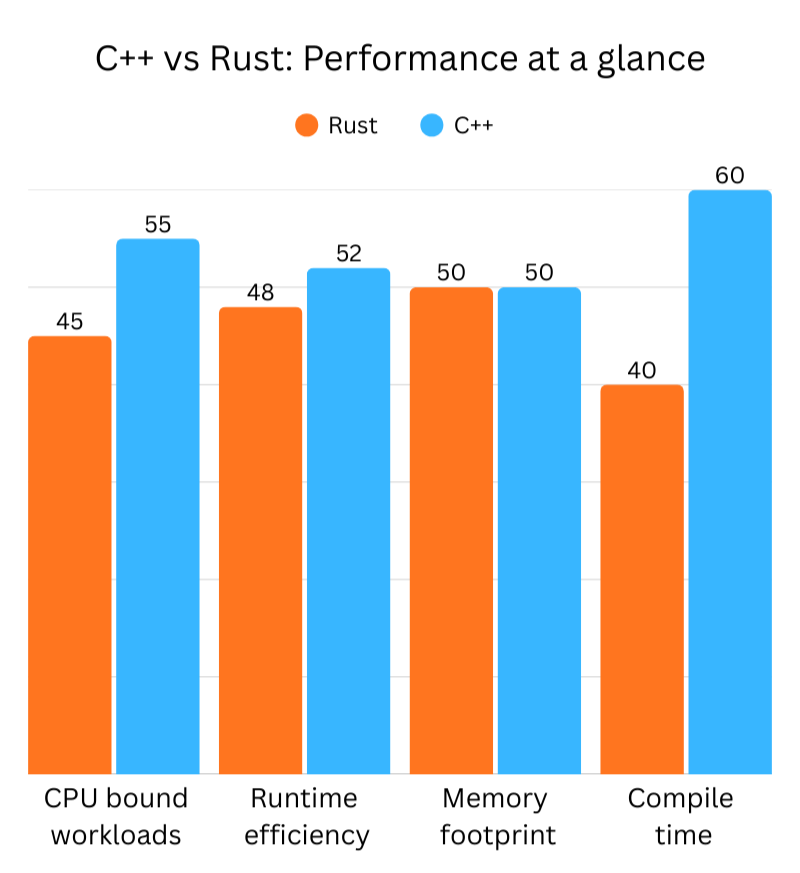
- The Computer Languages Benchmark Game is an ongoing project that compares languages on common algorithms like binary trees, regex, and n-body simulations. C and C++ tend to win out, but Rust is often within 5–10% – and beats the older language on some measures.
- In some cases, Rust is a clear winner – including PNG decoding, where Rust-based memory-safe decoders “vastly outperformed” libraries for C thanks to efficient concurrency and safer memory handling.
- An Arxiv paper by Patrik Karlson compared matrix multiplication, merge sort, and file I/O operations – revealing C++ performs better at matrix math, but Rust beats it in merge sort, for similar overall performance when the benchmarks balance out.
For any benchmark pitting C++ against Rust, the C++ solution is probably more optimized than the Rust version; there are simply more C++ programmers out there with more years of experience. And straight benchmarks don’t show any of the sweat, toil, and tears behind the algorithm, such as how many times the C++ developer has to recompile versus a Rust counterpart. Coding isn’t just about benchmark scores; it’s about the process and reliability of the code
The pure benchmarks show roughly equivalent performance numbers, with Rust a few percent behind most of the time. So in domains demanding the last drop of low‑latency speed, C++ is marginally ahead. But here’s the insight: C++’s lead comes from “lab conditions” tests, and that lead disappears in “real world” tests.
In other words, in the messy reality of a real coding team solving real problems, Rust draws level with C++ and is often ahead. And when you stir Rust’s strengths into the mix – like memory and thread safety guarantees – there are further surprises in store.
Quick Summary:
- Rust: slightly behind in pure benchmarks, safer concurrency
- C++: slightly ahead in microbenchmarks, requires high skill for safety
Taking out the trash: memory safety in C++ and Rust
C++ requires manual memory management, using
newanddeleteor smart pointers likestd::unique_ptrandstd::shared_ptrto control object lifetimes. While static and dynamic analysis tools can detect many memory issues, they are not foolproof.
Rust enforces strict rules at compile time through a system of ownership, borrowing, and lifetimes. Every value in Rust has a single owner; if that ownership moves – as in passing a variable to a function – the original reference is invalidated unless deliberately borrowed across, with a “borrow checker” in the Rust compiler catching miscreants before the code is ready to run.
Here’s a handy table of the key differences.
| Feature | Rust | C++ |
| Memory allocation | Automatic via ownership and lifetimes | Manual via raw pointers and smart pointers |
| Deallocation | Handled deterministically when owner goes out of scope | Must be made explicit or managed with smart pointers |
| Dangling pointer protection | Guaranteed at compile time with borrow checker | No compile-time guarantees and a common source of bugs |
| Use-after-free | Caught at compile time | Undefined behaviour |
| Double free | Prevented by ownership model | Must be manually avoided |
| Concurrency safety | Enforced at compile time, so no data races unless explicitly marked | No automatic protection, with data races common |
| Null pointer issues | Option<T> replaces nullable pointers in safe code | Null dereferencing is often a cause of crashes |
| Unsafe code | Allowed but must be clearly marked | The usual case, with all code potentially unsafe |
| Tooling | Compiler enforces safety before runtime | Tools needed for runtime detection |
Rust’s system reduces runtime bugs and improves reliability. C++ offers maximum freedom, but safety depends entirely on the developer’s discipline.
Addressing complexity: the systems programmer’s learning curve
Neither C++ nor Rust is an easy language for coding newbies. Both are industrial-strength tools, used to build operating systems, graphics engines, embedded systems, and other critical software. Writing reliable code in these languages requires focus, discipline, and careful planning.
Rust can feel particularly challenging at first. Its borrow checker, ownership model, and lifetimes introduce concepts that many developers have not encountered before. For programmers coming from Python, or Java, the compiler may seem strict, but this strictness prevents many types of bugs before the code runs. Certain patterns, such as shared mutable state or cyclic data structures, work differently in Rust, which can make initial prototyping slower.
Some coders have compared it to flying a plane: ultimately you’ll travel faster, but there are far more checks and tests to do before you get off the ground.
C++ is not easier. Its large feature set, templates, and legacy complexity can be overwhelming, even for experienced programmers. Reading and maintaining complex C++ code is notoriously difficult, and many developers cite this as a persistent challenge.
The key difference is that Rust catches many potential issues at compile time. Unsafe operations are still possible, but the compiler clearly flags them. Over the life of a project, this leads to fewer runtime crashes, more predictable performance, and safer, more maintainable code.
To help developers navigate Rust’s learning curve, JetBrains offers several educational resources:
- Rust exercises in RustRover Vitaly Bragilevsky’s blog introduces RustRover’s built-in practice experience and explains how the environment guides learners through Rust concepts with real-time feedback. The post will give you an overview of how the exercises work inside the IDE.
- Learn Rust plugin (compatible with RustRover and CLion): A guided learning plugin that teaches Rust fundamentals through interactive lessons, editor hints, and instant feedback. It works in both RustRover and CLion, so developers can learn inside the IDE while writing real code.
- 100 Exercises to Learn Rust : Based on 100 Exercises to Learn Rust by Mainmatter’s Luca Palmieri, this course gives you a hands-on, test-driven path through Rust, starting with your first
println!and progressing to advanced concepts like ownership, lifetimes, pattern matching, and generics.
With these resources, developers can build confidence in Rust gradually. While the learning curve is initially steep, the payoff is significant: safer code, fewer bugs, and more predictable development outcomes.
Tooling up: assessing C++ and Rust toolchain philosophies
While they’re far more accessible today than 20 years ago, low-level languages can make taking applications from beta to gold a Hard Problem. This means tooling is critical to productivity. C++ has long been the power player, but Rust with a more modern design philosophy and greater focus on developer experience, gives a strong showing.
Here’s our head-to-head.
C++: it’s powerful, but fragmented
- C++ has a rich ecosystem, but it’s decentralized, with tools often optimized for a specific environment or purpose.
- Diverse build systems like Make, CMake, Meson, Bazel, and Ninja mean C++ developers spend a lot of time getting builds to work consistently across platforms. The State of C++ 2025 report provides a clear overview of how these tools are used in practice across many teams and platforms.
- Package managers, including
vcpkg,conan,hunter, and others, compete vigorously, but there’s no consensus or standards informing the contest, increasing complexity. - The compilers –
gcc, clang, MSVC, and more – each have their own quirks, flags, and extension sets; this means writing portable C++ needs ultra-deep toolchain awareness. - Static analysis tools like
clang-tidy, cppcheck, andCoveritycan detect issues, but they’re hard to set up, especially for newcomers learning the C family. - IDEs like Microsoft’s Visual Studio and JetBrains’ own CLion, Rider, and ReSharper C++ (the JetBrains extension for Visual Studio) offer very mature support, but some advanced features still require additional plugins, which adds setup work for developers.
Summing up: while C++ offers great freedom and maturity in its tool space, the developer experience is inconsistent … and often demands in-depth knowledge to navigate effectively.
You can try Rust right inside CLion. The Rust plugin is free for everyone and works seamlessly with your existing C++ setup. Use both languages in one IDE and switch between them whenever you need.
Rust: the “all batteries included” option
Rust ships with a unified, opinionated toolchain that just works:
cargo, Rust’s combined package manager and build system, handles compilation, dependencies, testing, benchmarking, documentation, and publishing in one box. Compared to C++, there’s no need to configure makefiles or wrangle libraries by hand.- Rust’s toolchain installer and updater,
rustup, lets coders switch between versions or targets without the gaps showing, while its IDEs RustRover from JetBrains offer smart autocomplete, inline type hints, and compiler-powered refactors. - With built-in formatting and linting,
rustfmtandclippylet the Rust pro enforce style and catch common pitfalls before runtime, without needing third-party tools. - Excellent documentation tooling –
cargo docgenerates browsable HTML docs automatically from inline comments. It’s not perfect, but it works.
Rust shows a clear advantage here: its newer tools are well-integrated, perform fast, and are largely standardized across the ecosystem. Once a coder joins the ranks of the Rustaceans (often from a C++ background) he/she will find sharper tools in the toolbox.
Communities, ecosystems, and demographics
C++ has a long history, dating back to the 1970s, and it remains a cornerstone of modern software. Its community is global, with strong presence in North America, Europe, China, and India. C++ is widely taught at universities, and there are over 13 million C/C++ developers worldwide.
Many are experienced professionals, with a significant portion of over 35 years. This depth of expertise and documentation means that for systems-level programming, almost any problem has been solved before, providing a strong support network for developers.
Rust, by contrast, belongs to a younger generation of languages. Its community is enthusiastic, fast-growing, and increasingly influential. Around 46% of Rust developers are under 30, while more than a quarter are in their 40s. Two-thirds have less than ten years of coding experience. Despite its relative youth, Rust has consistently been named the “most loved language” by Stack Overflow for nine years in a row. Most Rust developers use the language for hobbies or side projects, but professional adoption is steadily increasing.

Both communities face similar demographic challenges: fewer than 6% of developers are female. Beyond demographics, the communities differ philosophically. C++ reflects decades of established practices and legacy systems, while Rust emphasizes modern safety, concurrency, and developer ergonomics.
C++ will remain a dominant force in systems programming for years due to its installed base and mature ecosystem. Rust, however, is gaining traction rapidly, attracting developers with its safety-first approach, modern tooling, and growing library ecosystem. Both communities provide strong support for developers, but each reflects the priorities and challenges of the era in which the language has evolved.
Some use cases: the best fit for C/C++ and Rust
Choosing between C++, Rust, and their differing ecosystems isn’t just about syntax or performance. There’s a long list of other things to consider: the demands of the project, the maturity of the team, the environment in which the code will live, the toolchains available and understood.
Both languages offer their users incredible power. They allow precise control and high performance. But they approach safety, tooling, and ergonomics very differently. Let’s summarize the differences with their strengths, weaknesses, and ideal use cases.
Short overview of C++
| Category | Summary |
| Key strengths | Broad platform support across industries; Extremely high performance; Mature ecosystem with deep domain libraries; Rich selection of compilers and toolchains; large and experienced talent pool |
| Key weaknesses | Manual memory management risks; Fragmented tooling; Undefined behaviors that surface as runtime issues; Accumulated complexity from decades of language evolution |
| Best use cases | Real-time and performance-critical systems; Extending or maintaining legacy C/C++ codebases; Game development; Embedded systems in automotive, industrial, consumer, and IoT environments |
Summarizing the Rustacean worldview: here are the pluses and minuses for the newer language.
Short overview of Rust
| Category | Summary |
| Key strengths | Memory and thread safety are enforced at compile time. Modern and unified tooling; (cargo, clippy, rust-analyzer)Safe concurrency; Strong documentation and package ecosystem.Eliminates broad classes of C/C++ style bugs |
| Key weaknesses | A steeper learning curve and smaller talent pool; Slower compile times; A less developed ecosystem for narrow or highly specialized domains |
| Best use cases | Security-sensitive software; Safety-critical embedded systems; New systems programming, such as kernels, drivers, and file systems; Concurrency-heavy services; Greenfield infrastructure where maintainability and safety must be engineered from the start |
Wrapping all up: A fair comparison with bright futures for both
C++ and Rust are less competitors and more companions. C++ is the battle-hardened veteran: proven, powerful, and deeply embedded in industrial software, game engines, and high-performance computing. Rust is the insurgent: modern, safe by default, and designed to prevent the mistakes C++ leaves to the programmer’s discipline.
This comparison isn’t about choosing a winner. Each language excels in different contexts. C++ gives expert developers maximum control across any platform. Rust trades some flexibility for reliability, catching many issues at compile time and making projects safer in the long run.
Both languages continue evolving. C++ adds modern features like ranges, concepts, and improved memory models. Rust improves compilation speed, performance, and ecosystem depth while gaining adoption across industries.
Rust didn’t come to replace C++. It provides another option: safe, fast, and enjoyable once you’re on top of the learning curve. The future isn’t C++ or Rust. It’s both, used where each makes the most sense. Let us know what you think in the comments.
Explore Rust for your next project with resources from JetBrains: JetBrains Academy and Rust exercises in RustRover.