Rust vs JavaScript & TypeScript: Performance, WebAssembly, and Developer Experience

TL;DR
- Rust and JavaScript/TypeScript aren’t competitors – they excel in different domains and are increasingly used together.
- JS/TS offers an unmatched ecosystem depth and rapid iteration, while Rust delivers performance, memory safety, and reliability.
- WebAssembly bridges the two, letting Rust power performance-critical logic inside JS/TS apps.
- Hybrid Rust + JS/TS architectures are now common across major companies and open-source projects.
- Rust adoption is accelerating, especially in backend, infrastructure, and Wasm-heavy workloads; JS/TS remains dominant for UI and full-stack flexibility.
- Modern teams often use JS/TS for the product layer and Rust for the engine beneath it, combining speed with flexibility.
Rust and JavaScript/TypeScript (JS/TS) are often perceived as rivals, but in reality, they’re complementary languages that serve different purposes and excel across different domains. They were designed with different goals in mind, which dictate the best use cases for each.
JavaScript/TypeScript offers benefits such as unmatched flexibility, a massive ecosystem, and rapid iteration. Meanwhile, Rust shines in projects that demand top-tier performance, memory safety, and system-level reliability.
And thanks to technologies like WebAssembly, Rust code can now integrate seamlessly with JS/TS environments, effectively serving as a high-performance engine under a flexible frontend. Such hybrid projects combining Rust with JavaScript/TypeScript are on the rise, reflecting a broader trend of language collaboration. A good example of that is a Rust and TypeScript project using WebAssembly, where Rust handles performance-critical logic, and TS manages the web-facing side.
This article dives into the current adoption and use cases of Rust and JavaScript/TypeScript to help you explore how these two languages can work together, including real-world commercial applications.
Rust and JavaScript: Where they stand in 2025
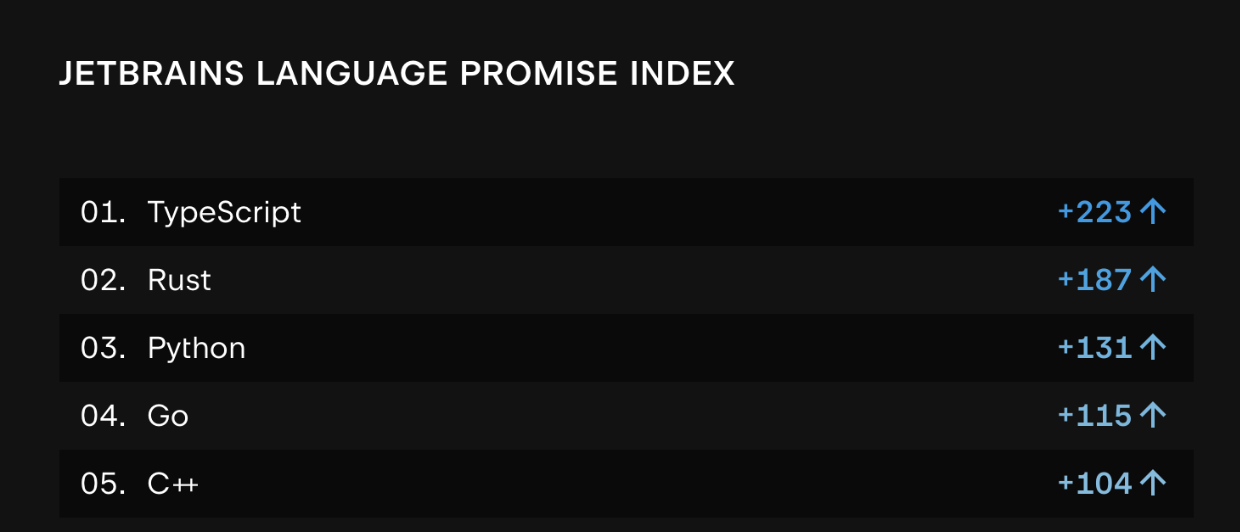
Today, Rust and JavaScript/TypeScript stand out as two languages shaping very different yet complementary domains. According to the 2025 Developer Ecosystem Survey, 10% of developers plan to adopt Rust next year, while TypeScript’s real-world adoption has been higher than any other language over the past five years. The survey’s Language Promise Index indicates that TypeScript, Rust, and Go have the highest perceived growth potential, while JavaScript, PHP, and SQL appear to have reached a plateau.
Let’s take a closer look at Rust and JavaScript/TypeScript to understand their place in the current software development landscape.
| Category | Rust | JavaScript / TypeScript |
| Primary strength | Performance and memory safety | Flexibility and massive ecosystem |
| Typical use cases | Systems programming, backends, WebAssembly modules, tooling engines | Frontend apps, full stack via Node, prototyping, product layer logic |
| Execution model | Compiled, strongly typed, predictable performance | Interpreted or JIT compiled, dynamic or gradually typed |
| WebAssembly support | First class, highly optimized | Works as host and integration layer |
| Developer experience | Steeper learning curve but excellent tooling through Cargo and RustRover | Very fast iteration, strong tooling in VS Code and WebStorm |
| Ecosystem | Growing crates ecosystem and strong system level tooling | Largest library ecosystem in the world |
| Ideal role in hybrid stack | Performance engine under JS/TS | UI layer, product logic, integration, DX |
Rust
In 2024, Rust achieved a significant milestone, reaching an estimated 2.27 million developers, with 709,000 identifying it as their primary programming language. This year, Rust continues to gain traction in areas where performance and safety matter. Its commercial usage increased substantially – between 2021 and 2024, the share of Rust developers using it in production grew by 68.75%.
Rust’s ecosystem is thriving across industries, powering everything from operating systems and browsers to cloud infrastructure, WebAssembly apps, embedded devices, and blockchain platforms. Leaders like Microsoft, Google, Amazon, and Meta rely on Rust for its unmatched blend of speed, safety, and scalability – whether in the Linux kernel or the AWS Firecracker microVMs.
There’s another rising use case of Rust that points to its natural fit alongside JavaScript/TypeScript: web development. According to JetBrains ecosystem data from 2024, Rust for web development is the third most popular use case, showing how well Rust integrates with the web dev ecosystem.
JavaScript / TypeScript
JavaScript remains a ubiquitous choice among developers – it has the largest usage share among professional developers (68.8% in 2025). TypeScript’s tooling and large ecosystem adoption make it a strong “next step” for JS teams. To illustrate the rise of TS: in August 2025, TypeScript overtook both JavaScript and Python in GitHub contributor usage.
The reasons behind this expanding adoption are clear: the JavaScript and TypeScript ecosystems offer remarkable flexibility, making them one of the most powerful environments for modern software development.
Developers can use both languages to build dynamic front-end interfaces and robust back-end services using frameworks like Node.js. This opens the door to developing full-stack applications with a single language. The speed and adaptability of JS/TS make them ideal for rapid prototyping, while the massive plugin and library ecosystems provide ready-made solutions for virtually any challenge, from UI frameworks to complex data handling.
“Rust is undoubtedly the big star in JavaScript and TypeScript tooling and infrastructure. It addresses the most significant issue in the current tooling ecosystem: performance. And I’m 100% convinced that the safeguards from language and compiler make it easier to create successful tools to begin with.”

Common Use Cases and Projects
Rust’s growing collection of web frameworks now mirrors many of the patterns familiar in JavaScript ecosystems, making it easier for teams to blend both worlds. Actix Web, Axum, Rocket, Warp, Loco, Cot, and full-stack tools like Leptos offer routing, middleware patterns, request handling, and component models that map conceptually to popular JS frameworks.
For example, Actix Web and Axum align with the role that Express or Fastify play in the Node.js ecosystem, while Leptos feels closer to React or Svelte in how it structures reactive UI logic, except it’s compiled to WebAssembly for performance.
How Rust Web Frameworks Map to Familiar JavaScript Patterns
Rust’s modern web frameworks feel approachable for developers coming from the JavaScript ecosystem. While they are different in typing and execution models, the core concepts like routing, middleware, handlers, and extractors follow patterns that JS developers already use daily.
- Actix Web is known for its speed and mature async runtime. It uses an actor model that let’s you build highly concurrent services without complex coordination logic. For teams experienced with high-throughput Node servers or frameworks like Fastify, Actix Web offers a similar emphasis on efficiency, but with Rust’s predictability and stronger guarantees around memory safety and performance.
- Axum takes a modular, middleware-driven approach. It’s built on top of the Tower ecosystem, and it promotes clear separation between routing, request handling, and service composition. Developers who appreciate the flexibility of Koa or modern frameworks in the Deno ecosystem often find Axum intuitive because it leans on composable primitives and a clean, type-first design. If you want to see this approach in action, this short Axum tutorial walks through a real example.
- Rocket focuses on ergonomics. Its declarative routing and macro-powered syntax reduce boilerplate and make handler definitions straightforward. This resonates with developers who enjoy the expressiveness of decorator-driven frameworks such as NestJS, but want the reliability of a compiled language. With Rocket 1.0 stabilized, the framework has become a dependable option for production APIs and prototypes alike.
Together, these frameworks show how Rust’s server-side ecosystem has evolved into a space where JS/TS developers can transition smoothly, adopting familiar patterns with the added benefit of stronger safety guarantees and more predictable performance
Why These Frameworks Matter in Hybrid Architectures
As more teams blend Rust with JavaScript or TypeScript, frameworks like Actix Web, Axum, and Rocket become essential building blocks for the backend or core logic layer. They address the limits that Node services often encounter, especially under high load, CPU-heavy operations, or strict latency requirements.
Rust’s concurrency model and predictable throughput make these frameworks a strong fit for performance-sensitive backend logic, while JS/TS continues to drive the UI and application layer.
They also integrate cleanly with modern API tooling, making it easy to expose REST or gRPC interfaces that TypeScript clients consume reliably. For teams working with WebAssembly, these frameworks complement workflows where browser modules and backend services share Rust-based components.
The result is a hybrid architecture where JavaScript drives the user experience and rapid iteration, while Rust powers the critical paths that require precision and speed.
Rust’s WebAssembly Capabilities and JavaScript Integration
WebAssembly serves as the practical bridge that allows Rust and JavaScript to collaborate within the browser. You can compile Rust directly to Wasm, allowing JavaScript to call into high-performance Rust functions whenever a task demands more speed or predictability than JS alone can provide.
This model is increasingly common as more teams use Rust-compiled Wasm for image processing, data visualization pipelines, physics simulations, cryptography, and other computation-intensive routines that would slow down or block a JS app if implemented purely in JavaScript.
The workflow is straightforward: JavaScript or TypeScript continues to handle the majority of the application, like UI rendering, event handling, state management, and routing, while Rust takes on focused, performance-critical modules.
What you get is a JS/TS application with specialized Rust components quietly accelerating the hardest parts.
Many teams now rely on this pattern, using Rust-powered WebAssembly modules to offload complex calculations while keeping the rest of the codebase in familiar JavaScript/TypeScript. It’s a complementary approach that strengthens modern web workflows without replacing established frontend practices (and causing lots of headaches!).
Real-World Patterns for Introducing Rust Web Frameworks into JS/TS Workflows
Teams adopting Rust alongside JavaScript and TypeScript often begin with incremental changes, using Rust frameworks as clean entry points into existing systems.
A common starting point is replacing a single Node microservice with an Actix Web or Axum service, especially for tasks like data processing, authentication, or analytics where Node struggles under load. TypeScript clients generated from OpenAPI help keep the integration smooth.
Another pattern is using Rocket or Axum to build backend services for React or Next.js applications. These Rust services offer predictable latency under high concurrency, while the JS/TS frontend maintains flexibility and fast iteration cycles.
For teams working with WebAssembly, Rust’s web frameworks pair naturally with workflows where browser modules and server components share Rust-based logic.
Together, these patterns show how Rust frameworks extend JS/TS workflows by handling performance critical components without disrupting the broader development process.
Rust vs JavaScript: Ecosystem, Tooling, and Developer Experience
Ecosystem
For developers coming from the JavaScript world, the Rust ecosystem can feel both familiar and refreshingly different. JavaScript thrives on its extensive library ecosystem, rapidly evolving frameworks, and package managers. Rust offers a more streamlined environment, with its standard toolchain centered around Cargo, which serves as a unified build system, dependency manager, test runner, and project scaffolder.
Tooling
On the tooling side, JS developers often rely on WebStorm or VS Code, while Rust developers increasingly use RustRover, IntelliJ with a Rust plugin or CLion with Rust support for a more integrated development experience.
According to the 2024 State of Rust Survey, VS Code remains the most commonly used editor for Rust, followed by Neovim and IntelliJ based IDEs, highlighting a split between lightweight editors and full featured IDEs depending on workflow preferences and project complexity.
Communities
When comparing communities, you can expect JavaScript’s scale to be unparalleled – reflecting decades of growth, numerous tutorials, and widespread industry adoption. Rust’s community is smaller but expanding rapidly, especially among developers seeking stronger safety guarantees or exploring alternatives to traditional Java-based backend stacks (this is why comparing Rust to Java makes so much sense!).
Developer experience
When surveyed using the JetBrains Language Promise Index, JavaScript sits firmly in the “mature and stable” category: widely adopted, battle-tested, and unlikely to fade. Rust, in contrast, scores high in terms of long-term potential and upward momentum. Its promise comes from a combination of safety, performance, and growing enterprise interest. These are traits that appeal to teams modernizing infrastructure or boosting their existing Java or JS stacks.
In practice, developers don’t have to choose between Rust and JavaScript. Rust brings predictability, performance, and modern tooling, such as Cargo and RustRover; JavaScript offers flexibility, a broad ecosystem, and a massive support network. Together, they form a complementary set of tools that let teams build faster, safer, and more maintainable software.
Developer Adoption of Rust vs JavaScript
Rust learning curve and resources
Rust adoption today spans a wide range of organizations – from cloud platforms to fast-moving startups – giving the programming language solid credibility in real-world production systems.
Companies we all know, like Cloudflare, Figma, Discord, Amazon, and Dropbox, use Rust for performance-critical services, security-sensitive components, or infrastructure tooling. Startups building developer tools, edge runtimes, and data platforms increasingly choose Rust for its blend of speed and safety.
In the open-source space, many modern projects combine Rust and JavaScript, using Rust for core engines and JavaScript/TypeScript for the surrounding UI or integration layers. Examples include frameworks, linters, build tools, and WebAssembly-powered libraries that offload heavy tasks from JS/TS to Rust.
If you’re curious about how to get started after seeing these real-world use cases, our blog post How to Learn Rust walks through a practical learning path.
Still, Rust’s learning curve can be steeper than JavaScript’s – especially in terms of the ownership and borrowing model. But once you understand these concepts, Rust tends to produce more predictable and maintainable systems. High-quality resources support this ramp-up: comprehensive documentation like Rust Book, courses and Rust exercises, and robust tooling such as RustRover.
This combination of industry adoption, open-source momentum, and strong educational materials makes Rust a reliable long-term skill for developers looking to expand beyond traditional JavaScript workflows.
Learning curve and resources for JS/TS developers
If you’re a seasoned JavaScript developer looking to dip your toes into the world of Rust, you can use plenty of beginner-friendly resources, such as in-depth Rust guides or community-driven guides focused on WebAssembly and JavaScript integration. For experienced engineers who love to learn right inside the IDE, RustRover is a strong solution. You get a faster and more structured way to learn the language, thanks to its intelligent tooling, code insights, and smooth project setup.
The Rust community itself is a major advantage: active forums, Discord servers, meetups, and strong tooling support create a welcoming environment for newcomers.
When exploring Rust, many JS/TS developers start small. For example, you can add a single Rust module to an existing JavaScript/TypeScript project to speed up a computationally intensive task, image transformation, or parsing operation – and then expand your Rust footprint as you gain confidence.
This incremental approach works well, especially in a job market where both junior developers (61%) and senior developers (54%) report challenges; expanding into Rust can open new opportunities without abandoning familiar JavaScript workflows. For JS/TS developers, experimenting with Rust isn’t about replacing what they know but enhancing their toolkit with a language that fits naturally alongside their existing skills.
How Rust and JS/TS Work Together
Modern teams are increasingly combining Rust and JavaScript/TypeScript in the same workflow, especially when performance is a key consideration. A common pattern is to compile Rust to WebAssembly and call it directly from JS/TS.
This is ideal for tasks such as data parsing, image processing, simulation code, or crypto routines, where Rust WebAssembly‘s performance offers a clear advantage. The approach complements the JS/TS side, which continues to manage UI, routing, and application logic.
As much as 85% of developers are already using AI assistants. The openness to adopt new tools opens the doors to experimenting with Rust and JavaScript hybrid architectures.
JS/TS handles frontend and routine development tasks, while Rust modules (including those implemented via WebAssembly) take on performance-intensive tasks or critical backend services. This illustrates complementary usage without claiming one language is superior.
Example: Calling a Rust-compiled Wasm module from TypeScript
import init, { compute_heavy_task } from "./pkg/my_rust_module.js";

async function run() {
  await init("./pkg/my_rust_module_bg.wasm");
  const result = compute_heavy_task(500000);
  console.log("Result:", result);
}

run();
This approach gives teams the best of both worlds: JS/TS drives the product experience, while Rust takes over for the parts that require speed, safety, or system-level control.
Commercial usage of Rust and JS/TS: 3 Examples
Figma
Figma is a web-based design platform that pairs Rust and WebAssembly with a TypeScript- and React-driven interface. Its core graphics rendering and heavy computational tasks are compiled from Rust to Wasm, giving the browser near-native performance for operations like vector math, canvas manipulation, and real-time collaboration updates.
Meanwhile, the application’s main interface, interaction logic, and overall user experience are built with TypeScript and React, allowing rapid iteration and a rich, responsive UI layer. This blend of Rust/Wasm for performance-critical work and JS/TS for product development speed is a central reason Figma feels both powerful and fluid inside the browser.
Biome
Biome is a performant toolchain for web projects. It provides developer tools that help maintain the health and consistency of those projects. It is designed to be used through LSP integrations in editors and the CLI to format and lint code.
Biome is designed to be used through a CLI and editor integrations via the Language Server Protocol. While it supports both JavaScript and TypeScript projects, Biome itself does not rely on JavaScript or TypeScript internally. Instead, it replaces traditional JavaScript based tooling like Prettier and ESLint with a Rust implemented alternative focused on speed, reliability, and developer experience.
“Biome aims to replace existing JavaScript tooling like Prettier and ESLint with a Rust-implemented toolchain that offers better performance and a more consistent developer experience.”

Cloudflare
Cloudflare’s edge computing platform relies heavily on Rust to power its secure, high-performance serverless runtimes, including the foundation of Cloudflare Workers. Rust handles the low-level execution engine, network operations, isolation layers, and overall runtime reliability.
On top of this Rust-powered infrastructure, developers write their actual edge logic in JavaScript or TypeScript, which Cloudflare compiles and runs across its global network. This pairing enables Cloudflare to provide a fast and secure edge platform built on Rust while offering developers the familiarity and flexibility of the JavaScript/TypeScript ecosystem.
Conclusion
As you can see, Rust and JavaScript/TypeScript work best not as alternatives but as complementary layers of the same stack. Bringing together Rust’s speed, safety, and accuracy with the adaptability and rapid development of JS/TS provides teams with a well-rounded method that works for everything from web applications to backend systems. Hybrid workflows – whether through WebAssembly, shared services, or modular backends – let you select the appropriate tool for each part of your architecture.
For anyone exploring this path, experimenting with mixed Rust + JS/TS projects is one of the most effective ways to understand their combined strengths. And with tools like RustRover streamlining the Rust development experience, adopting these workflows has never been more accessible.
If you’re experimenting with Rust and JavaScript integration, RustRover provides a streamlined environment for managing your Rust toolchain, inspecting WASM, and working across hybrid projects.

Subscribe to Rust Blog updates