Rust Developer Ecosystem Survey 2025: Popularity, Trends, and Future

Based on findings from the JetBrains Developer Ecosystem Survey Report 2025, Rust Developer Ecosystem Survey 2025 offers a detailed look at how the Rust ecosystem is evolving – how developers use Rust today, which tools they use, how much they rely on AI tools in their workflows, and where the language is gaining momentum.
With Rust continuing to attract a strong wave of new developers and expanding into new areas of application, the report provides a clear snapshot of a language that is maturing quickly while still inspiring curiosity, experimentation, and long-term professional adoption.
Is Rust still popular in 2025?
Yes, Rust remains both popular and in demand in 2025. The survey shows that developers continue to adopt Rust across learning, hobby, and professional contexts, indicating sustained interest rather than short-term experimentation.
Note: The survey provides statistically meaningful insights into Rust adoption, developer experience levels, and usage patterns across different types of projects.
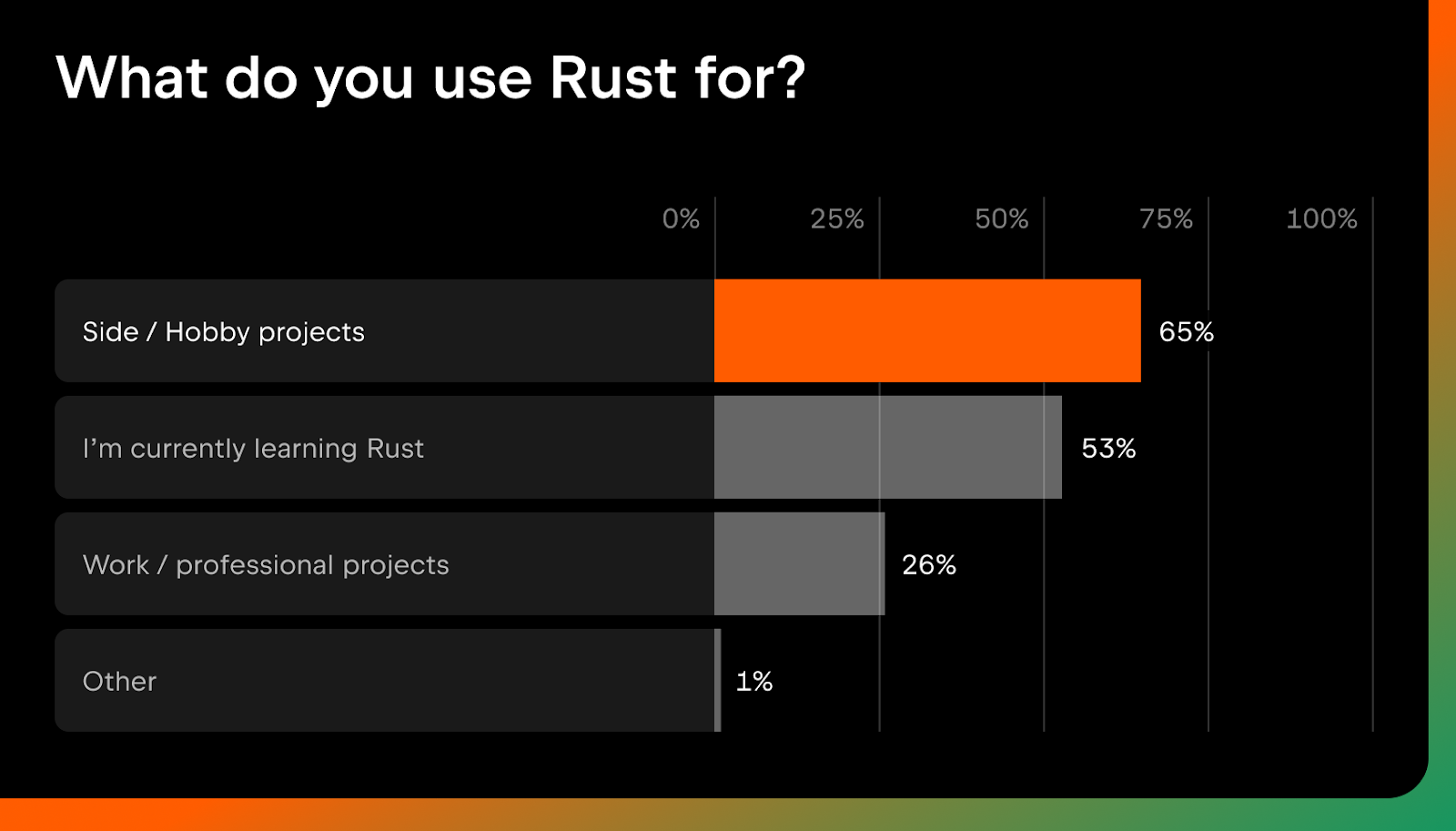
65% of respondents say they use Rust for side or hobby projects, while 52% report that they are currently learning the language. At the same time, 26% of developers already use Rust in professional projects. This mix highlights a healthy adoption pattern in which experimentation and learning coexist with real-world usage.
Newcomers continue to fuel Rust’s popularity
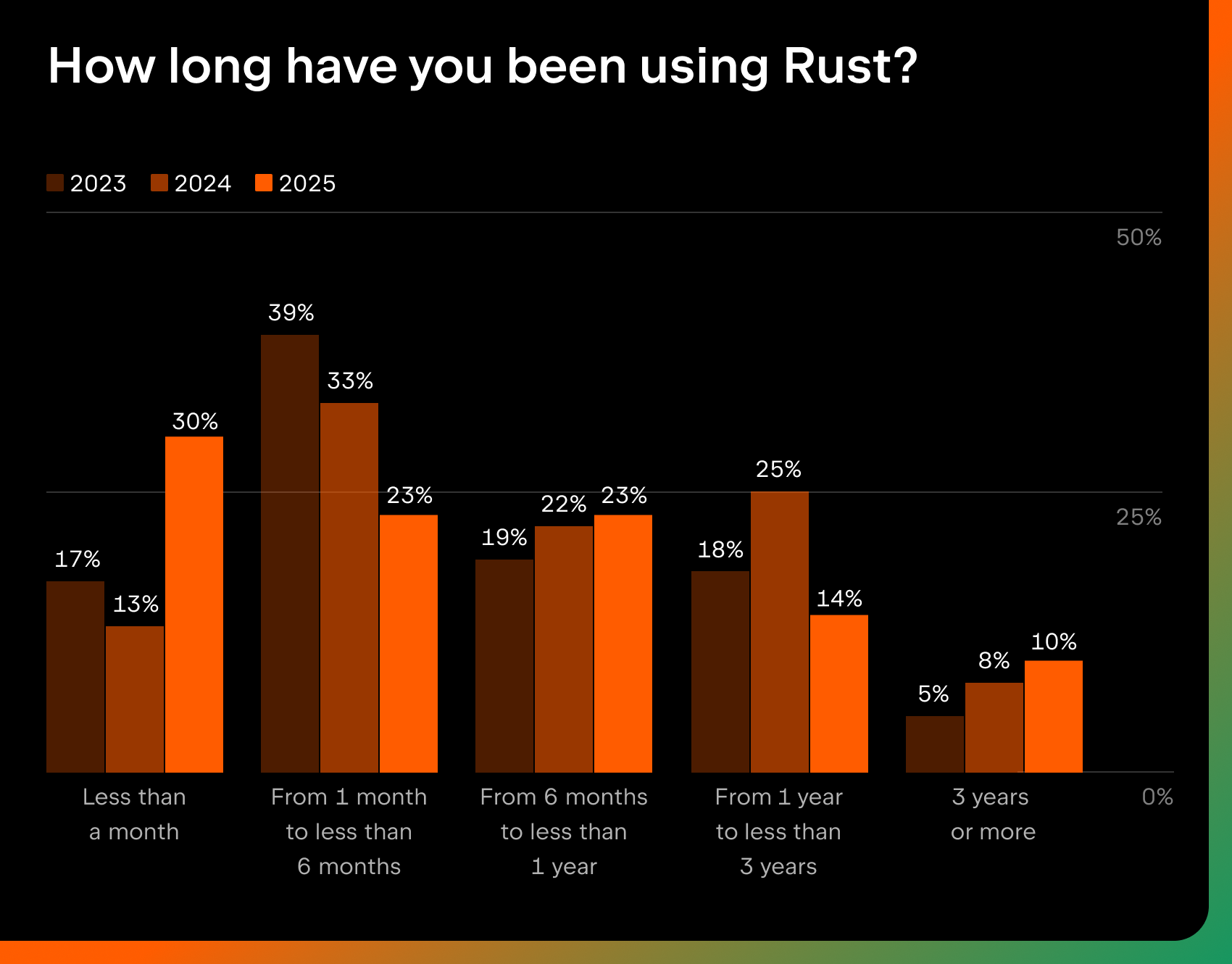
Rust’s momentum is reinforced by a steady influx of new users. In 2025, 30% of respondents reported that they started using Rust less than a month ago. This is a significant increase compared to previous years and a clear sign that interest in Rust is not slowing down.
At the other end of the spectrum, the share of developers who have been using Rust for 3 years or more continues to grow, showing that Rust not only attracts newcomers but also retains long-term users.
“My teaching experience this year has been a lot of groups moving to Rust from existing C and C++ projects, particularly in the government and government-adjacent sector. They are generally having a pretty positive experience, and the language has evolved sufficiently that the learning curve doesn’t feel vertical anymore to these users.”

Why does Rust remain popular?
Developers continue to choose Rust for its performance, memory safety, and reliability. As tooling, documentation, and learning resources improve, Rust becomes easier to adopt without losing its core strengths.
Together, these factors explain why Rust remains popular. Developers are not just talking about Rust – they are learning it, experimenting with it, and increasingly using it in real projects.
Who uses Rust today?
To understand the changing demographics in the Rust ecosystem, it helps to look beyond raw numbers and focus on who these developers are. The Rust community in 2025 combines a large number of newcomers with a strong base of experienced developers, making for a unique and balanced ecosystem.
Most Rust users are experienced developers
The majority of Rust users already had programming experience before they started learning it. This means Rust adoption is largely driven by developers who have worked with other languages and systems and are making a conscious choice to explore Rust. These are not beginners picking a first language, but professionals and hobbyists looking for better tools.
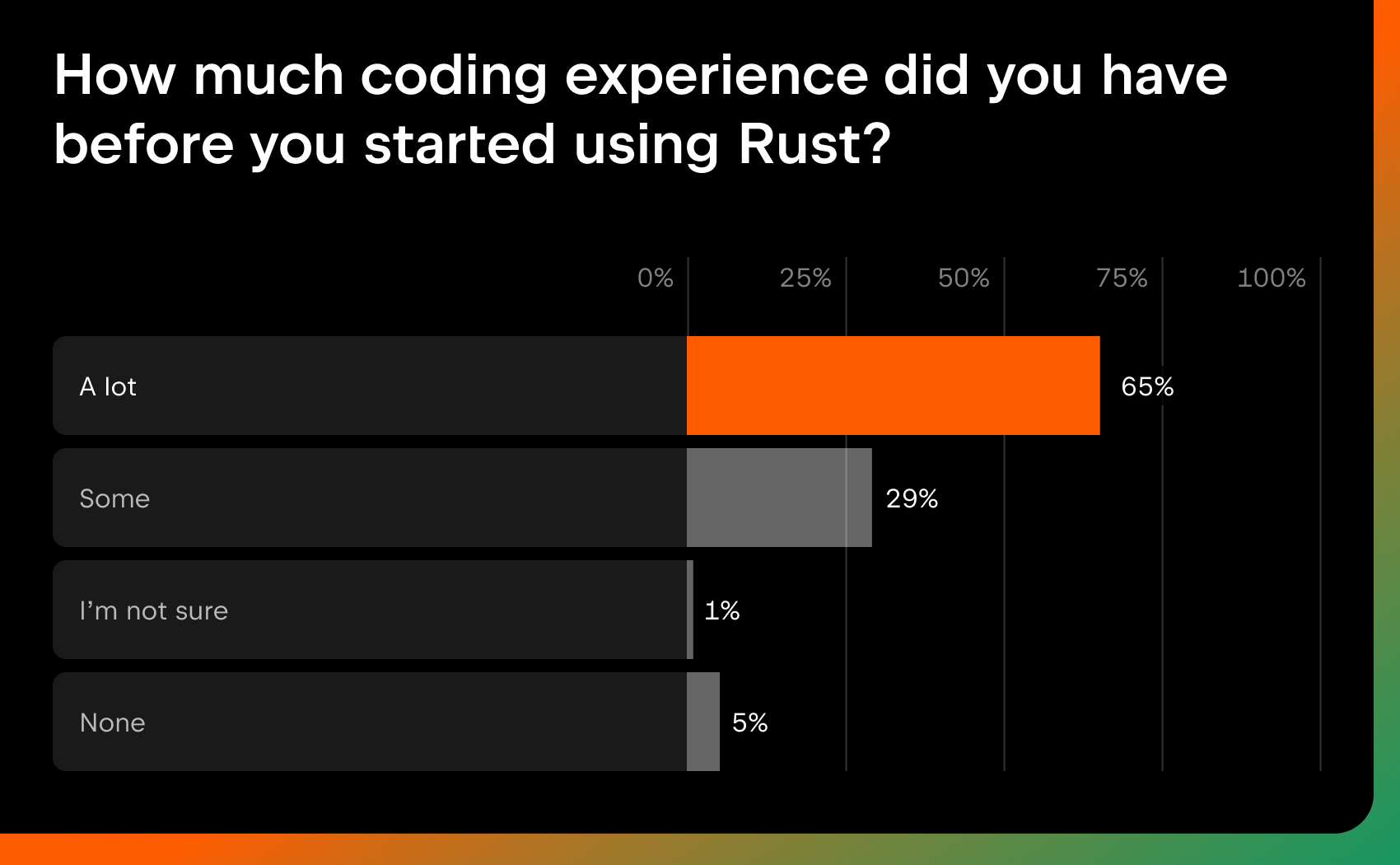
“Wow – what a fascinating graph. Although many would see this and think only 1 in 20 Rust programmers learned it as their first language, I am delighted to see that we attract so many. I hope that they are enjoying building.
It must be said though that Rust generally attracts programmers with more experience. I see two main reasons for this – one positive and one negative.
On the positive side for Rust, it’s clearly attracting people who are frustrated with the alternatives. Rust offers a viable alternative to brittle and insecure software. It’s wonderful that the language is a magnet for smart people. Learning a language requires a certain amount of grit. Rust justifies that investment.
Viewed more negatively though, there could be a warning here. It seems Rust’s reputation for being too difficult has become quite sticky. It definitely took a few attempts before I learned the language, and I’ve been hoping that we’ll be better at enabling “Rust as a first programming language” for some time.
AI agents are not intimidated by the Rust learning curve, though. Its type hints and error messages mean that coding agents can learn Rust very well. And given that learners will be driving those agents, we can expect that more learners will explore “hard” languages, including Rust.
With all that said however, perhaps this graph just shows that Rust is still small. Non-dominant language communities will always have a high proportion of members with experience from elsewhere.”

Developers come to Rust from many ecosystems
Many developers who adopt Rust arrive from widely used languages such as Python, Java, TypeScript, C++, and JavaScript. This diversity helps explain why Rust appears in so many different contexts. Web developers, backend engineers, and systems programmers all bring their own expectations and use cases, pushing the ecosystem to grow in multiple directions at once.
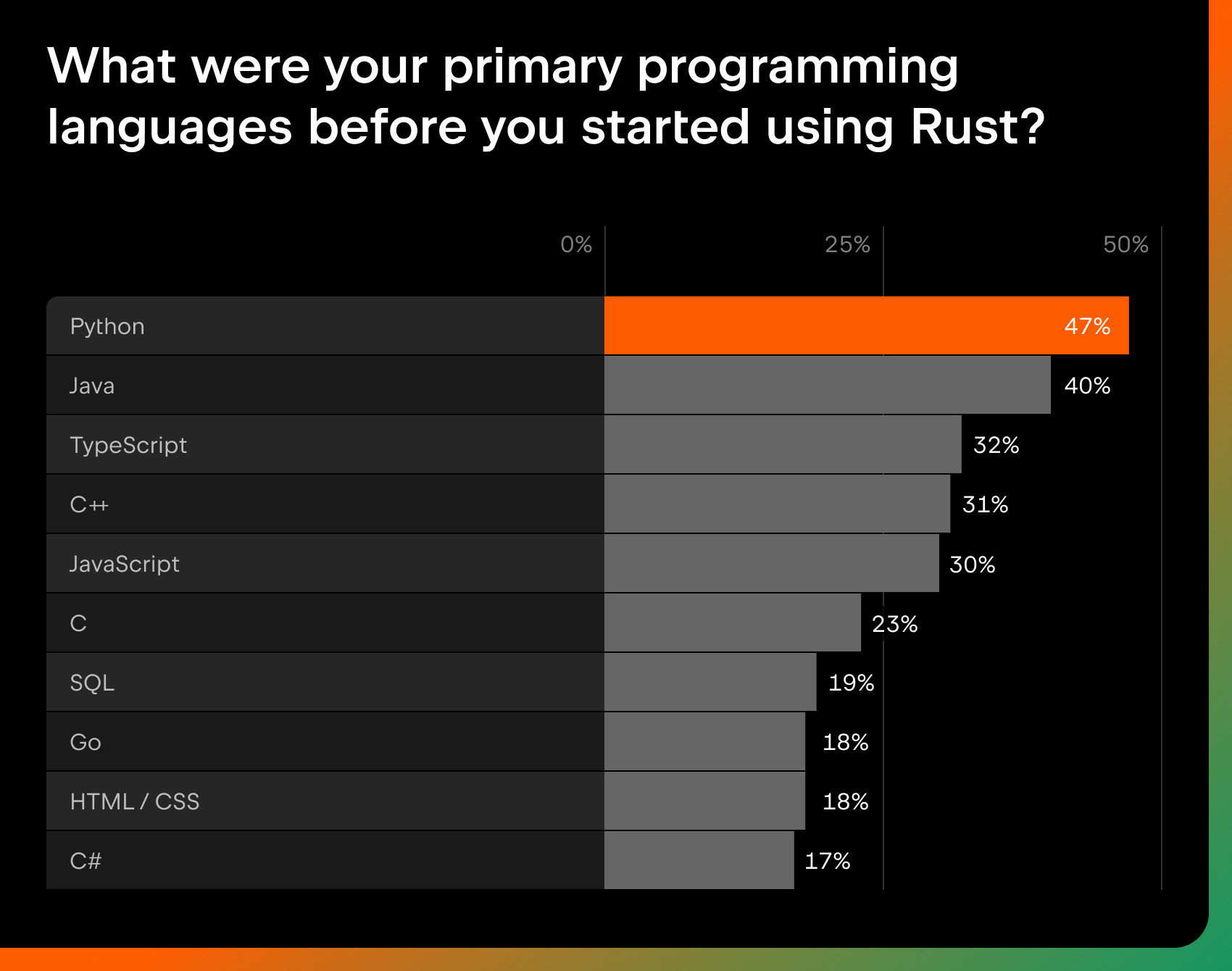
This mix of experience and backgrounds helps Rust mature faster. Newcomers benefit from an ecosystem shaped by real-world demands, while experienced developers help validate Rust as a serious option for long-term projects.
“All roads lead to Rust!
Furthermore, Rust is increasingly a brownfield language: it shows up alongside the languages people already know, not instead of them.
Python developers reach for Rust (via PyO3/maturin) to speed up hot paths without rewriting their entire codebase. Ruby and Elixir shops do the same via native extensions. Meanwhile, C and C++ teams use Rust to incrementally harden their systems: new modules in Rust, old ones migrated over time, the two coexisting at the FFI boundary for months or years.
”

Why newcomers choose Rust
While many Rust users are experienced programmers, a large share are still new to Rust itself. This steady flow of newcomers is one of the most important forces shaping the ecosystem.
Many developers begin exploring Rust with clear motivations: They want performance without sacrificing safety, or stronger guarantees than they’ve experienced in other languages. Rust’s focus on memory safety, correctness, and predictability aligns well with these goals.
To help developers navigate Rust’s learning curve, JetBrains provides several educational resources designed to support different learning styles and experience levels.
- How to Learn Rust: Vitaly Bragilevsky’s guide lays out a practical approach to learning Rust, explaining the language’s core concepts, common beginner challenges, and how tools like RustRover can support the learning process. It offers clear strategies, recommended resources, and a realistic path for newcomers to build confidence with Rust.
- Learn Rust plugin: This guided learning plugin teaches Rust fundamentals through interactive lessons, editor hints, and instant feedback. It works in both RustRover and CLion, so developers can learn inside the IDE while writing real code.
- 100 Exercises to Learn Rust: Based on 100 Exercises to Learn Rust by Mainmatter’s Luca Palmieri, this course offers a hands-on, test-driven path through Rust, starting with your first println! and progressing to advanced concepts like ownership, lifetimes, pattern matching, and generics.
These resources make it easier for you to move from curiosity to confidence. They help explain not just how Rust works, but why it works the way it does, which is key to mastering the language.
The Rust Ecosystem Today: Tools, Workflows, and Maturity
A language’s success with newcomers depends not only on syntax or features, but on how well developers can work with it day to day. These workflows reduce friction, making Rust easier to pick up and Rust projects easier to maintain over time. In 2025, Rust’s ecosystem shows clear signs of maturity.
Tooling plays a central role in this progress. Cargo provides a consistent foundation for building, testing, and managing dependencies, while formatting and linting tools help teams maintain quality and consistency. These workflows reduce friction and make Rust projects easier to maintain over time.
What developers build with Rust in 2025
Rust’s use cases offer a clear view of where the ecosystem stands today. Let’s look at what developers are actually building with it.
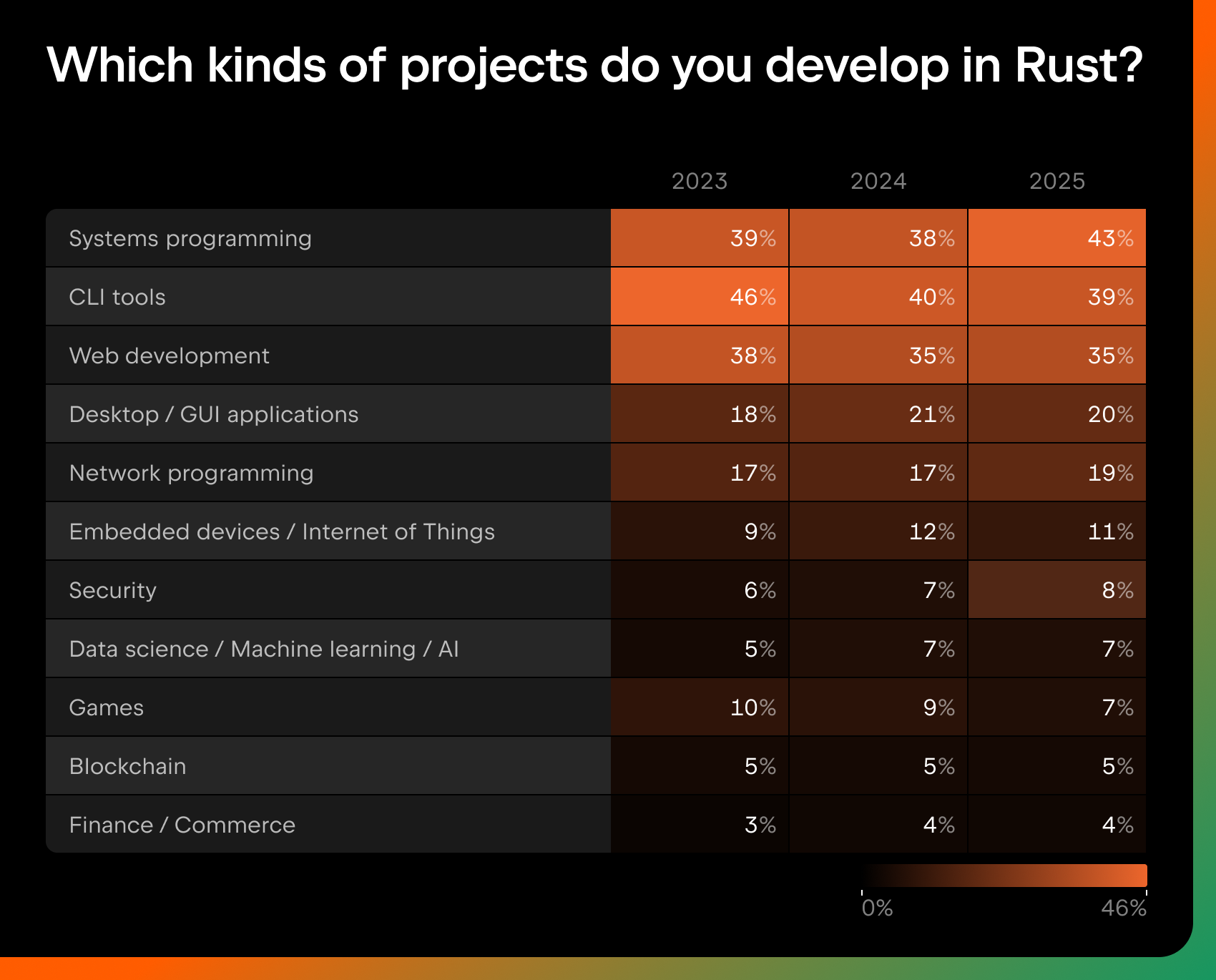
Systems programming and command-line tools continue to sit at the heart of Rust’s identity. These domains reflect the problems Rust was originally designed to solve, and they still attract developers who need performance, control, and safety.
At the same time, Rust’s role has broadened significantly. Web and backend development are now common use cases, showing that Rust is increasingly trusted for building services and APIs. This shift matters because backend systems are often long-lived and business-critical, so choosing Rust here signals confidence in its stability and ecosystem support.
Beyond its core areas, Rust is used in networking, embedded systems, security, scientific computing, and early AI-related tooling. While some of these domains are still smaller, their presence shows that developers are willing to apply Rust to a wide range of challenges. The ecosystem no longer fits a narrow definition, and that flexibility supports long-term growth.
Rust rarely lives alone in real projects
Rust is most often used alongside other programming languages rather than in isolation. JavaScript and TypeScript lead this list, followed by Python, SQL, and shell scripting languages. This reflects how Rust is commonly integrated into existing stacks, powering performance-critical components while working alongside higher-level languages.
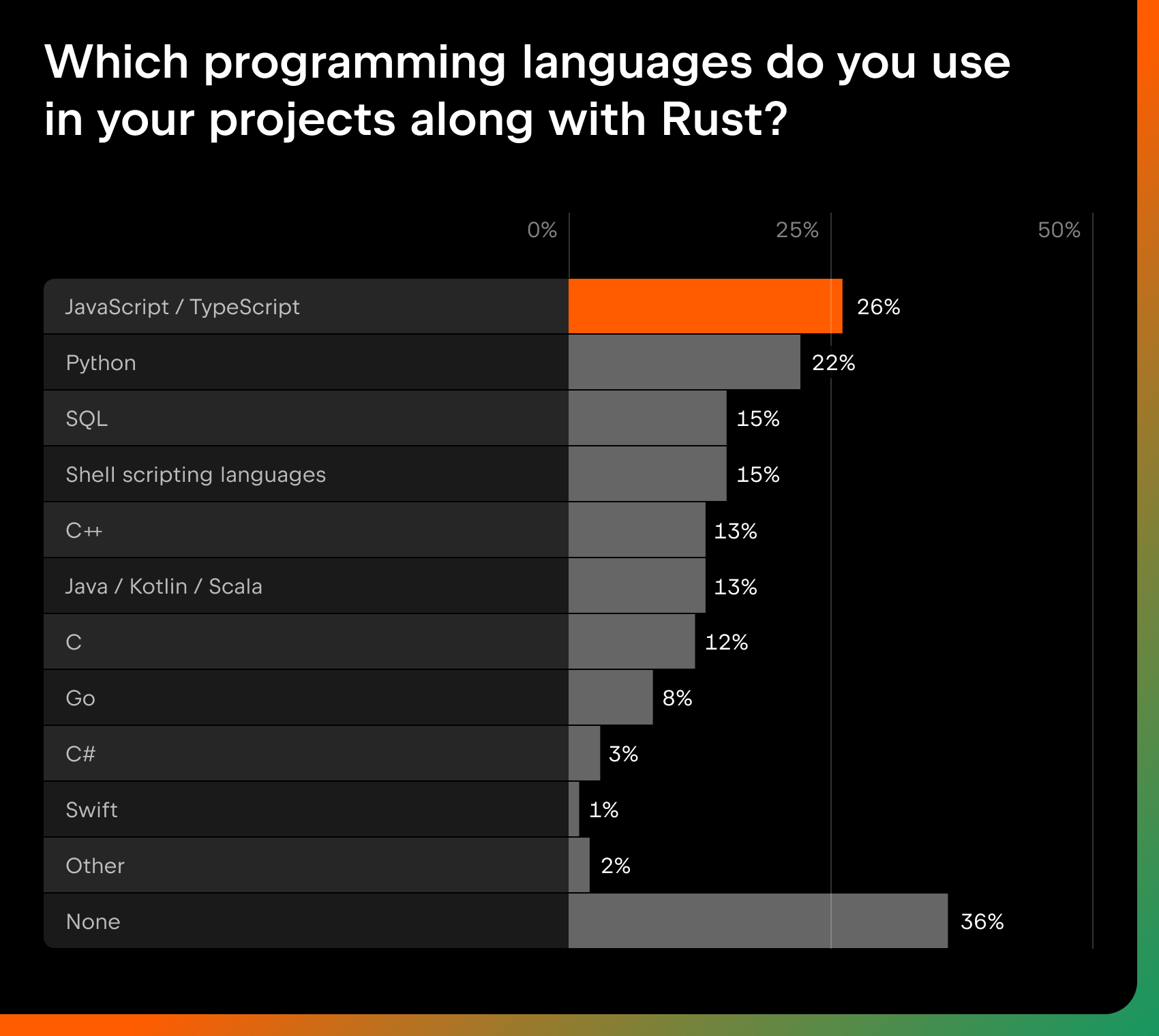
The presence of languages like C, C++, Java, and Go further highlights Rust’s role in mixed environments, especially in systems, backend, and infrastructure projects. At the same time, more than one-third of respondents report using Rust on its own, showing that the language is also mature enough to support complete projects end to end.
“Rust is often described as a true all-purpose language that successfully covers a wide range of tasks. The data confirms this, as the top entries among complementary languages are JavaScript/TypeScript and Python. JavaScript/TypeScript holds an exclusive position in the world’s largest runtime, the browser, and this is difficult to challenge. Python, on the other hand, is indispensable in many sectors due to its accessibility and incredibly rich ecosystem. And well, I think SQL falls into this category as well. However, when you consider all the other languages, there’s no reason not to switch to Rust, except perhaps to keep legacy projects alive. I’m curious how this will change in the future. My prediction is that the bars at the bottom of this chart will become much smaller over the years.”

Rust targets production platforms first
Rust projects overwhelmingly target production environments. Linux is by far the most common platform, used by three-quarters of respondents, reflecting Rust’s strong presence in server, cloud, and infrastructure workloads. Windows and macOS also see substantial usage, confirming Rust’s role in cross-platform development. This focus on production and infrastructure aligns with broader industry adoption trends discussed in the LWN analysis of Rust’s role in modern systems software.
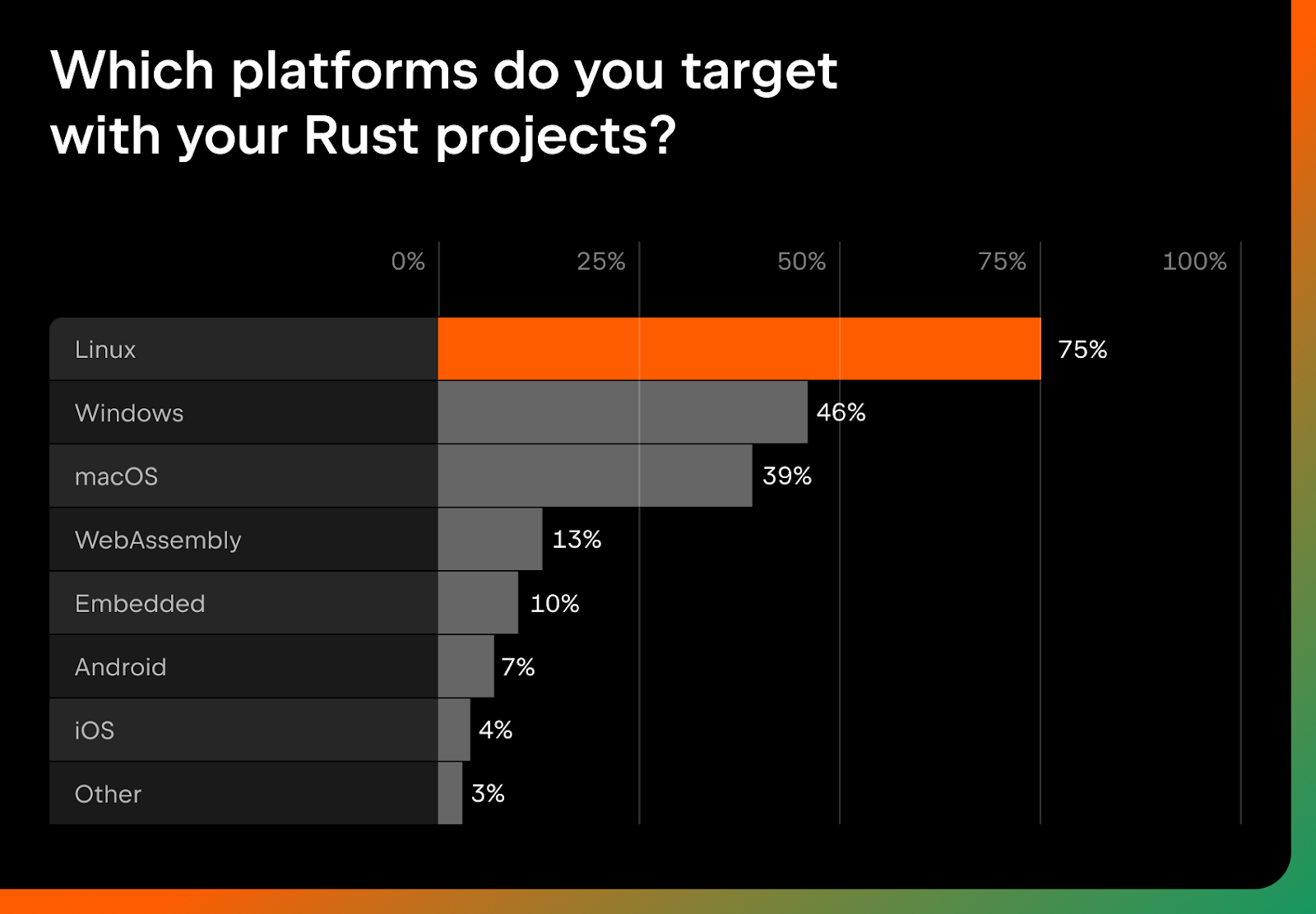
Beyond traditional operating systems, Rust continues to expand into specialized environments. WebAssembly and embedded targets are used by a meaningful share of developers, while mobile platforms appear less frequently. These results show that Rust is primarily chosen for reliability and performance in production systems, with growing interest in newer deployment models.
AI adoption in the Rust developer workflow
Artificial intelligence has become a visible part of everyday development work, and Rust developers are no exception. The 2025 survey shows a community that is actively experimenting with AI tools while remaining thoughtful about how these technologies fit into long-term workflows.
How Rust developers feel about AI
Rust developers approach AI with a mix of optimism and caution. One-third of respondents describe themselves as hopeful about AI’s increasing role in society, while others express uncertainty or anxiety. This balance reflects a community that values progress but also cares deeply about correctness, safety, and long-term impact.
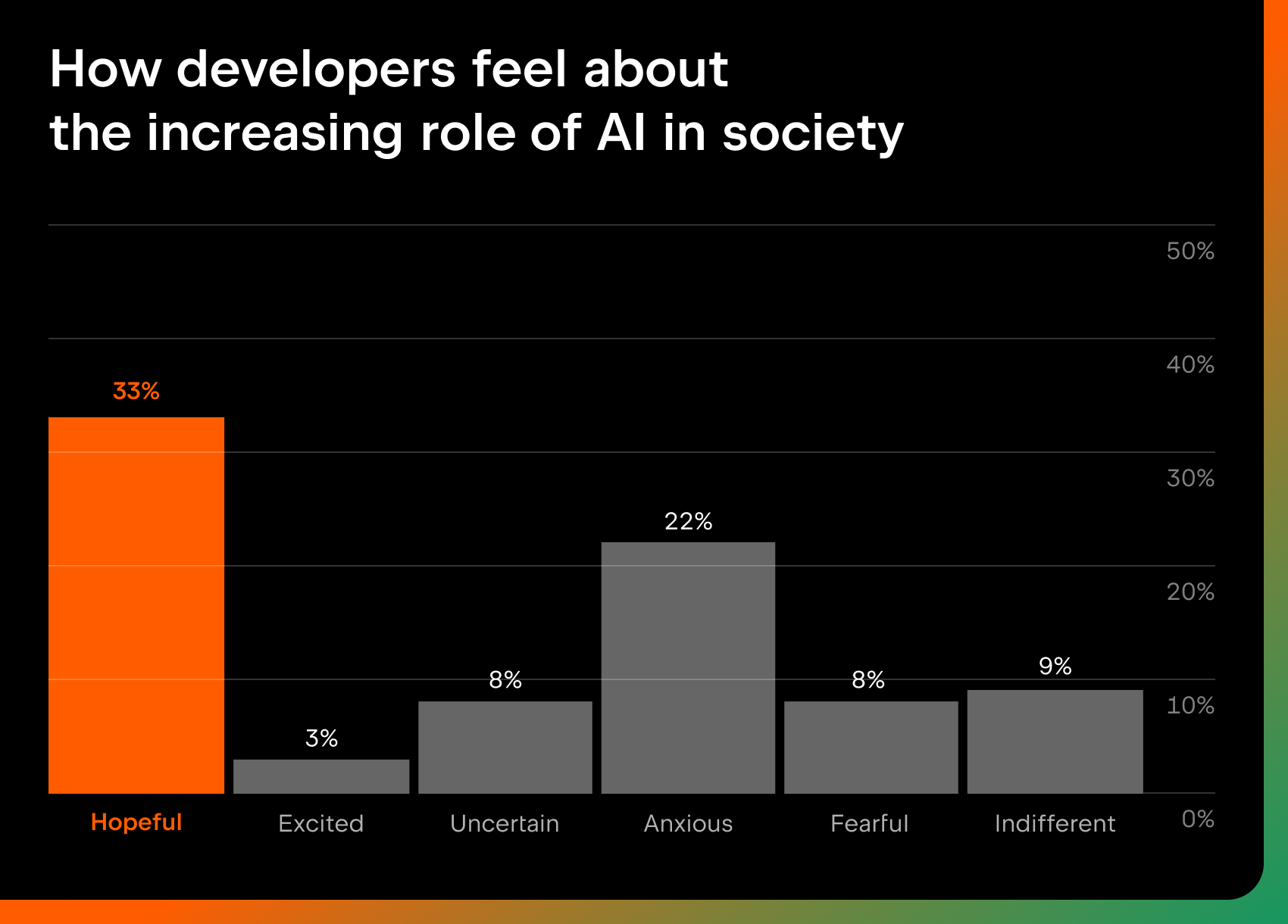
Rather than reacting emotionally, many Rust developers appear to be evaluating AI through a practical lens. They are interested in productivity gains, yet remain aware of the limitations and risks. This mindset aligns closely with Rust’s broader culture of deliberate design and explicit trade-offs.
“It makes perfect sense! We’re a community that explicitly chose strict correctness over quick hacks. The ‘Hopeful’ group sees a tool to handle the boilerplate; the ‘Anxious’ group is just worried about debugging hallucinations. Optimism is high, but the code review standards remain higher. Cheers!”

AI tools are already part of everyday development
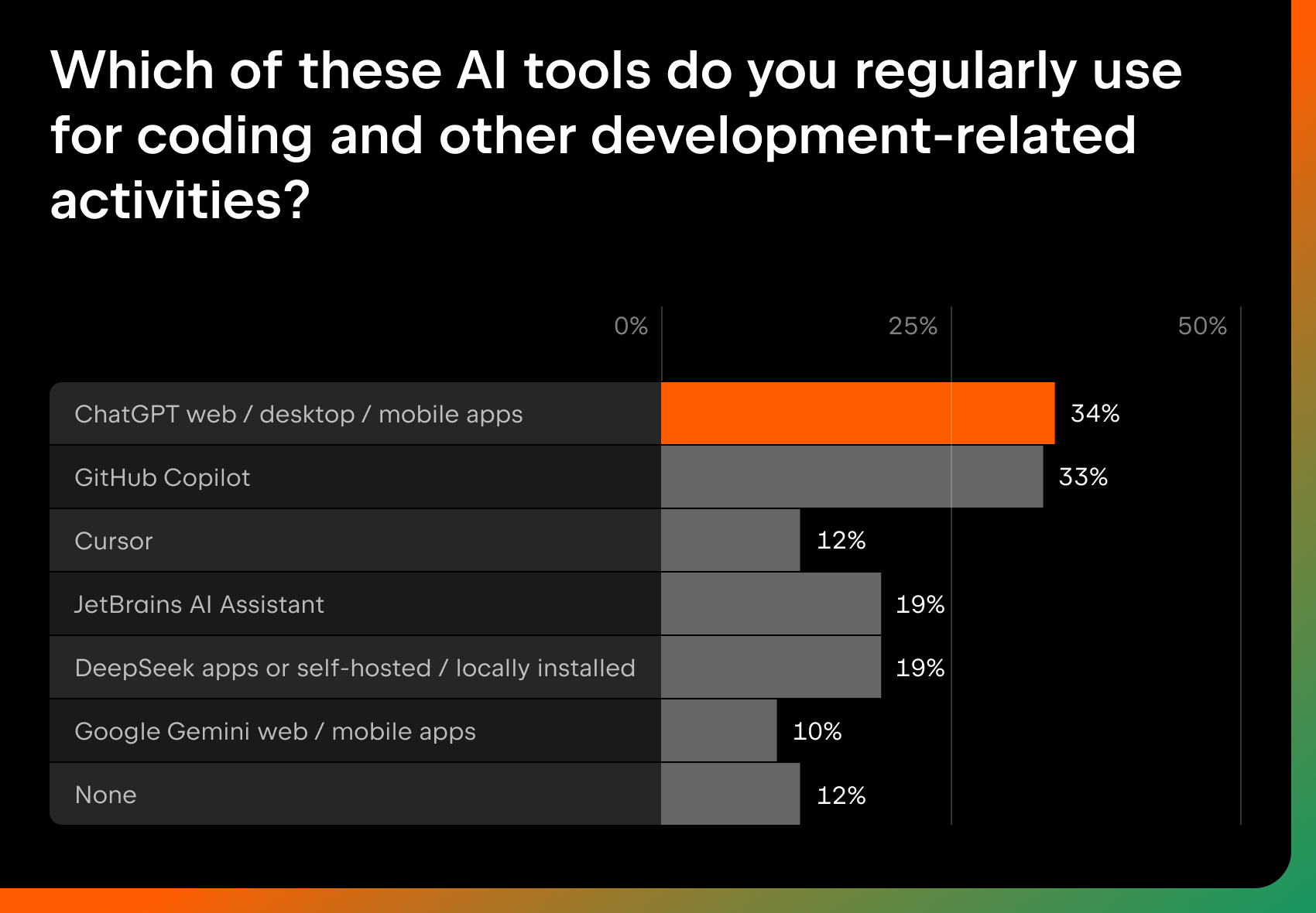
AI tools became a familiar part of Rust development in 2025. According to the survey, 89% of respondents have tried at least one AI tool, and 78% are actively using AI-powered coding assistants. ChatGPT and GitHub Copilot lead in regular usage, while dedicated AI editors and JetBrains AI Assistant are also widely explored.
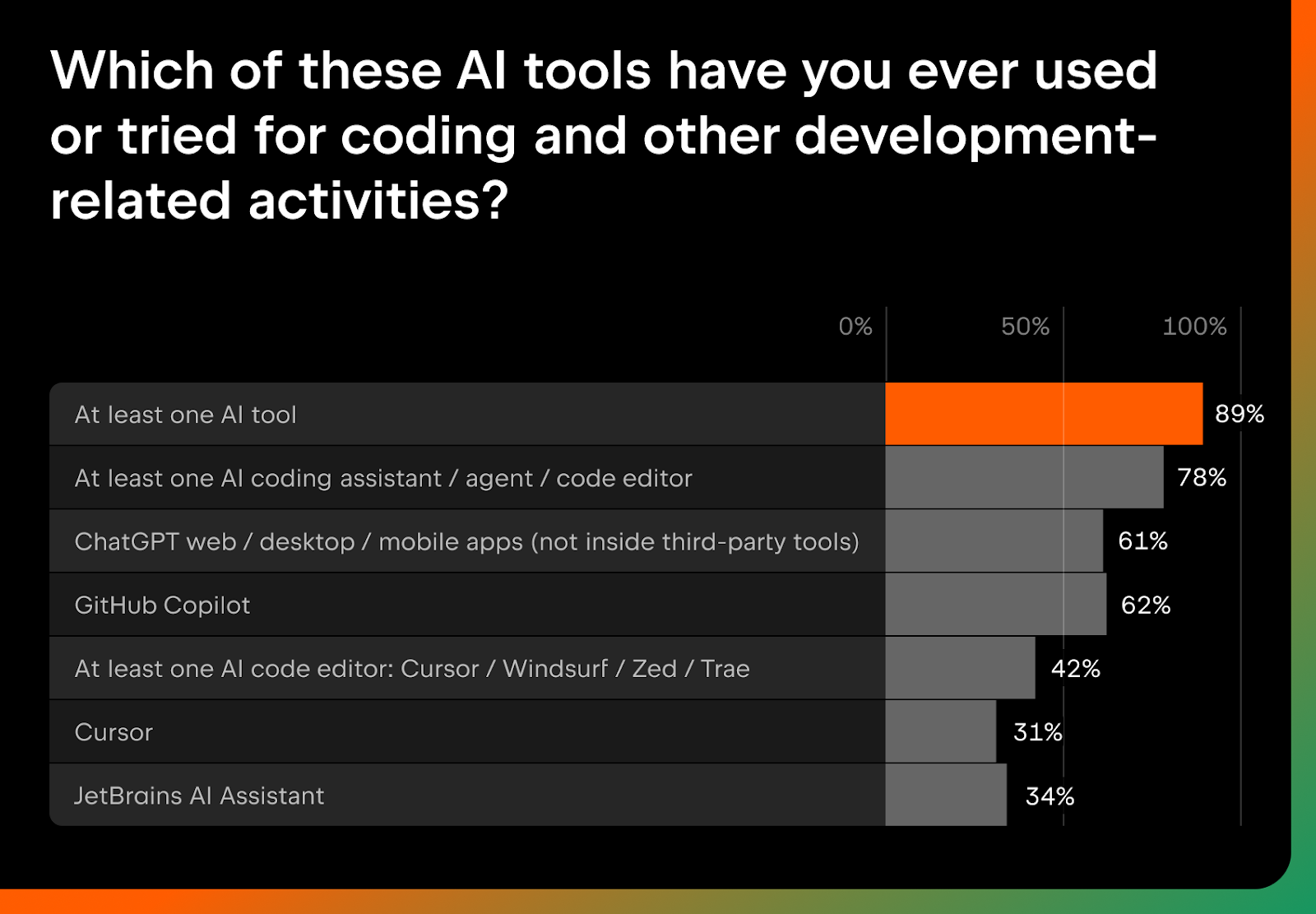
Usage patterns show diversity rather than dominance by a single tool. Developers combine general-purpose AI assistants with IDE-integrated solutions, choosing what fits their workflow rather than committing to one approach. This flexibility suggests that AI is becoming another tool in the toolbox, not a replacement for developer judgment.
Regular usage and interest in AI coding agents
AI tools are clearly embedded in day-to-day work. About one-third of Rust developers regularly use ChatGPT, with GitHub Copilot close behind. IDE-integrated assistants are also gaining traction, reflecting a preference for AI support that fits naturally into existing development environments.
Here are the AI coding assistants, agents, and code editors most commonly used for Rust development in 2025:
Looking ahead, interest in AI coding agents is strong but measured. Around one-quarter of respondents say they are very likely to try coding agents in the next year, while others remain unsure or cautious. This split highlights a familiar Rust pattern: curiosity paired with a desire for control, transparency, and reliability.
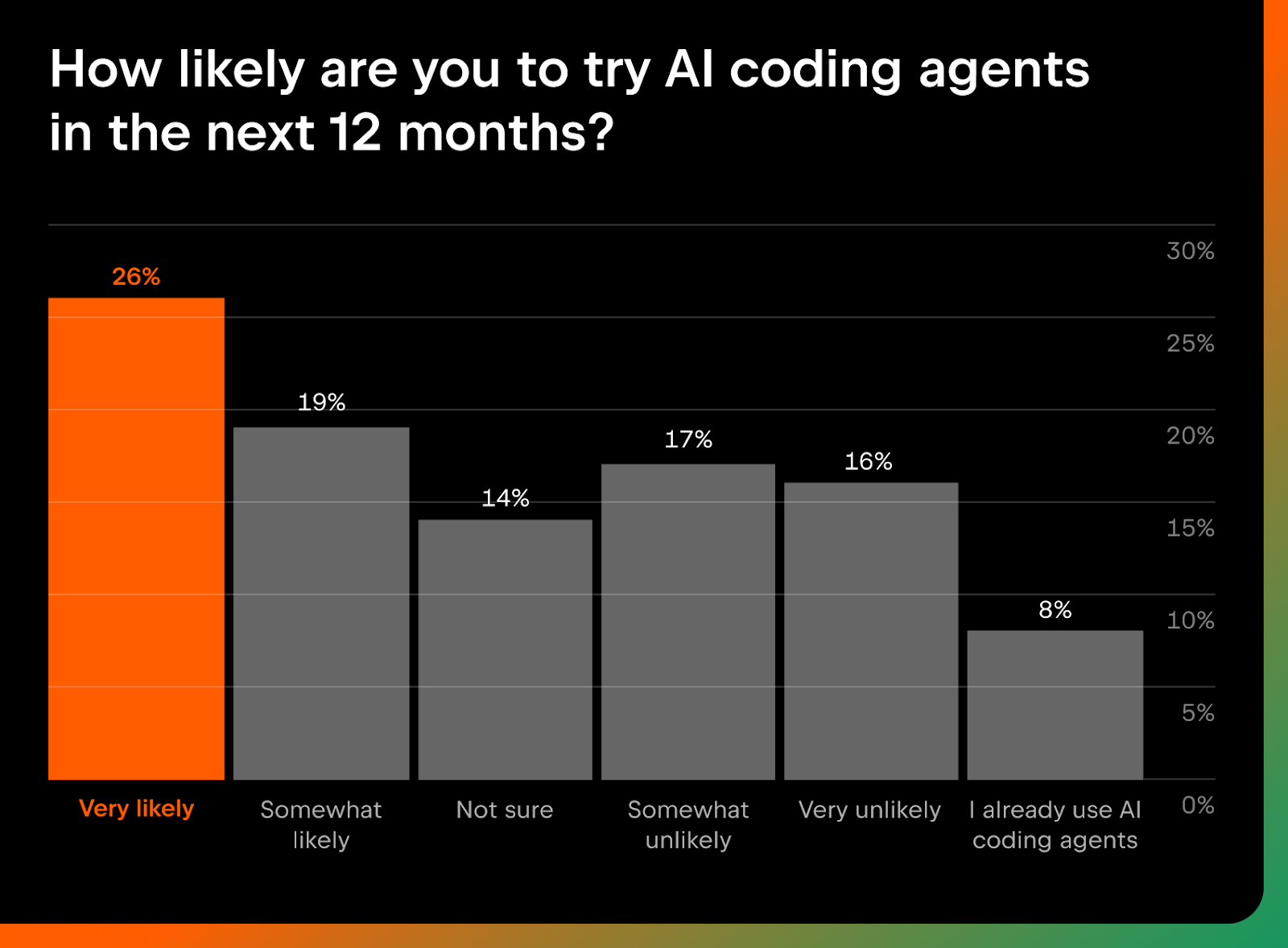
Overall, the data suggests that Rust developers are not resisting AI, but rather integrating it carefully. They adopt tools that provide real value today, while remaining selective about more autonomous systems. This thoughtful adoption mirrors how the Rust ecosystem itself has evolved – steadily, intentionally, and with a focus on long-term quality.
“Newer models are growing more capable of working in large, complex codebases. Rust’s built-in documentation, expressive type system, and readable compiler errors provide agents the context they need to work effectively. Whether using them for code review, complex refactors, expanding test coverage, or exploring new features, I am excited to see how experimenting with these new tools can help us all ship more robust and resilient software.”

What 2025 tells us about Rust’s future
Data from the JetBrains Developer Ecosystem Report 2025 points to a strong and stable future for Rust. A growing community of newcomers ensures continued interest, while experienced developers bring production-grade use cases that deepen trust in the language. Expanding adoption across backend services, infrastructure, embedded systems, and emerging AI tooling suggests that Rust’s role will continue to broaden.
Improvements in tooling and workflows further support long-term adoption. As Rust becomes easier to learn and more comfortable to use at scale, it is well-positioned to remain relevant as industry needs evolve. Rust’s trajectory reflects steady growth built on reliability and thoughtful design, rather than short-term trends.
A huge thank you to the Rust experts who contributed their expertise, helping us turn these numbers into a much more meaningful story!