Supercharge your tools with AI-powered features inside many JetBrains products
Has your team's sprint velocity actually improved since you approved all those AI coding tools? If not, recent research by JetBrains and UC Irvine shows your developers may be facing a new dimension of context switching that resists the usual fixes. The key findings were that most …
This opinion piece by JetBrains’ Team Lead in AI Development Experience reflects on key takeaways from NeurIPS 2025, a major AI research conference. It explains why these insights matter and considers related signals emerging from other recent research.
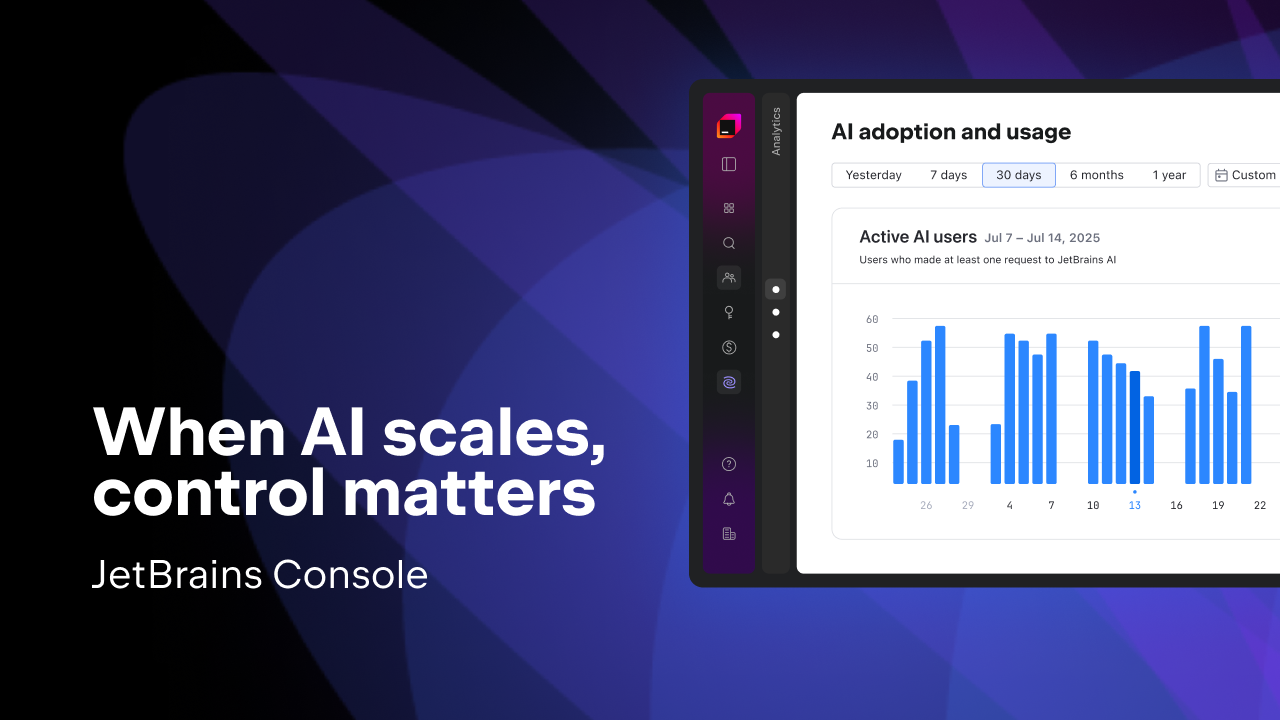
We’re introducing the JetBrains Console, which provides enhanced AI management and analytics for organizations, including new capabilities to manage, observe, and control AI usage and costs across teams.
Diffusion models, and in particular diffusion large language models (d-LLMs), operate differently from current coding assistants. Unlike autoregressive models, which generate token by token and line by line in a strict left-to-right sequence, d-LLMs condition on both past and future context.
Every developer recognises the trade-off. You can take the shortcut that delivers today but breaks tomorrow, or choose the slower approach that earns lasting confidence.
Instantly deploy a trusted, transparent code completion model without additional fees.
This summer, we're making Mellum, our code completion model, easier for developers to use locally, and we’re introducing support for more languages than ever.
AI agents are already in your tools—now it’s time to understand them. Learn to build and work with them responsibly in this free course by JetBrains and Nebius.
I was testing my agent built on Koog, JetBrains' open-source framework for building AI agents in Kotlin. I fed it a task from SWE-bench-Verified, a real-world GitHub issue that tests whether AI can actually write code. For the first 100 messages, everything looked promising. The agent methodicall…
At AI Summit London 2025, Kris Kang, Head of Product for AI at JetBrains, gave a talk that questioned a common belief in AI development: that bigger means better.
AI is no longer a distant idea. It’s already here and changing how we build software. As it advances, new questions emerge about its impact.
In May, 145 JetBrains employees from across teams and time zones paused their regular work to participate in a 48-hour AI hackathon. With support from Google Cloud, the participants built a total of 41 prototypes from scratch. Some were practical, others experimental, but all explored how AI could change how developers work.