Supercharge your tools with AI-powered features inside many JetBrains products

Previously in this series: Building AI Agents in Kotlin – Part 1: A Minimal Coding Agent Building AI Agents in Kotlin – Part 2: A Deeper Dive Into Tools Two articles in, and our coding agent can already do quite a bit. It can explore projects, read and write code, execute shell comman…
In the previous article, we saw how to build a basic coding agent with list, read, write, and edit capabilities. Today, we'll dive into how to extend the agents’ capabilities by creating additional tools within the Koog framework. As an example, we’ll be building an ExecuteShellCommandTool, teaching…
Diffusion models, and in particular diffusion large language models (d-LLMs), operate differently from current coding assistants. Unlike autoregressive models, which generate token by token and line by line in a strict left-to-right sequence, d-LLMs condition on both past and future context.
Building agents is weird. You're not writing code that does things. You're writing code that gives an LLM the ability to do things, and the LLM decides what to do. What is an agent? An agent is an LLM that calls your functions in a loop until it decides the task is complete. That shift takes s…
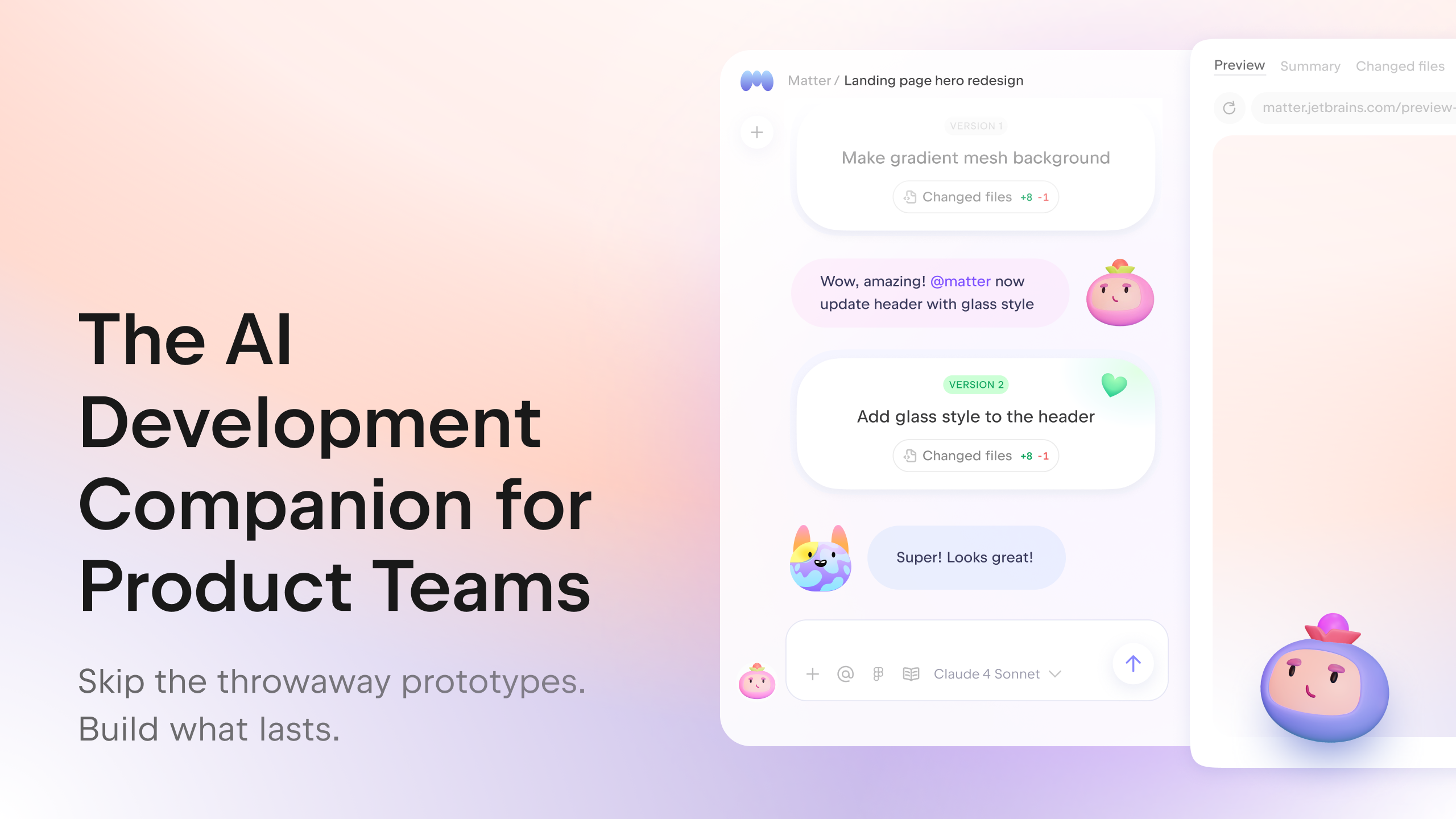
Every developer recognises the trade-off. You can take the shortcut that delivers today but breaks tomorrow, or choose the slower approach that earns lasting confidence.
At JetBrains, we've spent 25 years building tools for developers. Over the past two years, we've seen that AI isn't just changing how developers write code – it's beginning to reshape the entire process of product development. Not only is AI making developers more productive, helping with everyth…
We recently released Koog 0.5.0, introducing full Agent2Agent (A2A) protocol support, which makes it easier than ever to build systems of interconnected AI agents in Kotlin. But A2A is just the beginning. Koog 0.5.0 brings a host of improvements that make agents more persistent, tools smarter, an…
If you’ve ever tried building a system of multiple AI agents, you’ve probably run into the problem. It starts simple enough: you’ve got one agent writing blog posts, another proofreading them, and maybe a third suggesting or generating images. Individually, they’re effective. But getting them to work together? That's where things might start falling apart.
Featuring Langfuse and W&B Weave Support, Ktor Integration, Native Structured Output, iOS Target, GPT-5, and More. Koog 0.3.0 was about making agents smarter and persistent. Koog 0.4.0 is about making them observable, seamlessly deployable in your stack, and more predictable in their outputs …
AI agents are already in your tools—now it’s time to understand them. Learn to build and work with them responsibly in this free course by JetBrains and Nebius.
In online learning environments, tasks can often stump students, which can be challenging to navigate since teachers can’t always be there to help. Our Education Research team develops innovative features for education tools and recently built a smart AI-based hints tool that provides personalized feedback for students who might need help solving tasks. This AI tool goes beyond the automated hints common in massive open online courses (MOOCs) and delivers tailored, effective guidance that helps students move forward.
Are you ready to dive into the world of AI agents and create your own from scratch? We’ve got just the thing for you! Join us this August for a two-part livestream series about Koog, JetBrains’ open-source agentic framework that empowers developers to build AI agents entirely in Kotlin. Whether y…