Supercharge your tools with AI-powered features inside many JetBrains products
Previously in this series: Building AI Agents in Kotlin – Part 1: A Minimal Coding Agent Building AI Agents in Kotlin – Part 2: A Deeper Dive Into Tools Building AI Agents in Kotlin – Part 3: Under Observation Building AI Agents in Kotlin – Part 4: Delegation and Sub-Agent Agents ev…
Previously in this series: Building AI Agents in Kotlin – Part 1: A Minimal Coding Agent Building AI Agents in Kotlin – Part 2: A Deeper Dive Into Tools Building AI Agents in Kotlin – Part 3: Under Observation In the previous installment, we saw how to set up tracing, which brings us t…
Previously in this series: Building AI Agents in Kotlin – Part 1: A Minimal Coding Agent Building AI Agents in Kotlin – Part 2: A Deeper Dive Into Tools Two articles in, and our coding agent can already do quite a bit. It can explore projects, read and write code, execute shell comman…
In the previous article, we saw how to build a basic coding agent with list, read, write, and edit capabilities. Today, we'll dive into how to extend the agents’ capabilities by creating additional tools within the Koog framework. As an example, we’ll be building an ExecuteShellCommandTool, teaching…
Building agents is weird. You're not writing code that does things. You're writing code that gives an LLM the ability to do things, and the LLM decides what to do. What is an agent? An agent is an LLM that calls your functions in a loop until it decides the task is complete. That shift takes s…
여러 AI 에이전트로 구성된 시스템을 구축해 보았다면, 아마도 문제를 겪어 보셨을 겁니다. 처음에는 꽤 단순하게 시작합니다. 한 에이전트는 블로그 게시물을 작성하고, 다른 에이전트는 이를 교정하며, 아마도 세 번째 에이전트는 이미지를 제안하거나 생성하도록 했다고 가정해 보겠습니다. 개별적으로 보면, 각 에이전트는 자기 일을 효과적으로 해냅니다. 하지만 함께라면 어떨까요? 여기서 문제가 생기기 시작합니다. 각 에이전트는 자신의 '언어'를 사용합니다. 한 에이전트는 상이한 API 인터페이스를 사용하고, 다른 에이전트는 고유한 메시지 형…
We recently released Koog 0.5.0, introducing full Agent2Agent (A2A) protocol support, which makes it easier than ever to build systems of interconnected AI agents in Kotlin. But A2A is just the beginning. Koog 0.5.0 brings a host of improvements that make agents more persistent, tools smarter, an…
If you’ve ever tried building a system of multiple AI agents, you’ve probably run into the problem. It starts simple enough: you’ve got one agent writing blog posts, another proofreading them, and maybe a third suggesting or generating images. Individually, they’re effective. But getting them to work together? That's where things might start falling apart.
Featuring Langfuse and W&B Weave Support, Ktor Integration, Native Structured Output, iOS Target, GPT-5, and More. Koog 0.3.0 was about making agents smarter and persistent. Koog 0.4.0 is about making them observable, seamlessly deployable in your stack, and more predictable in their outputs …
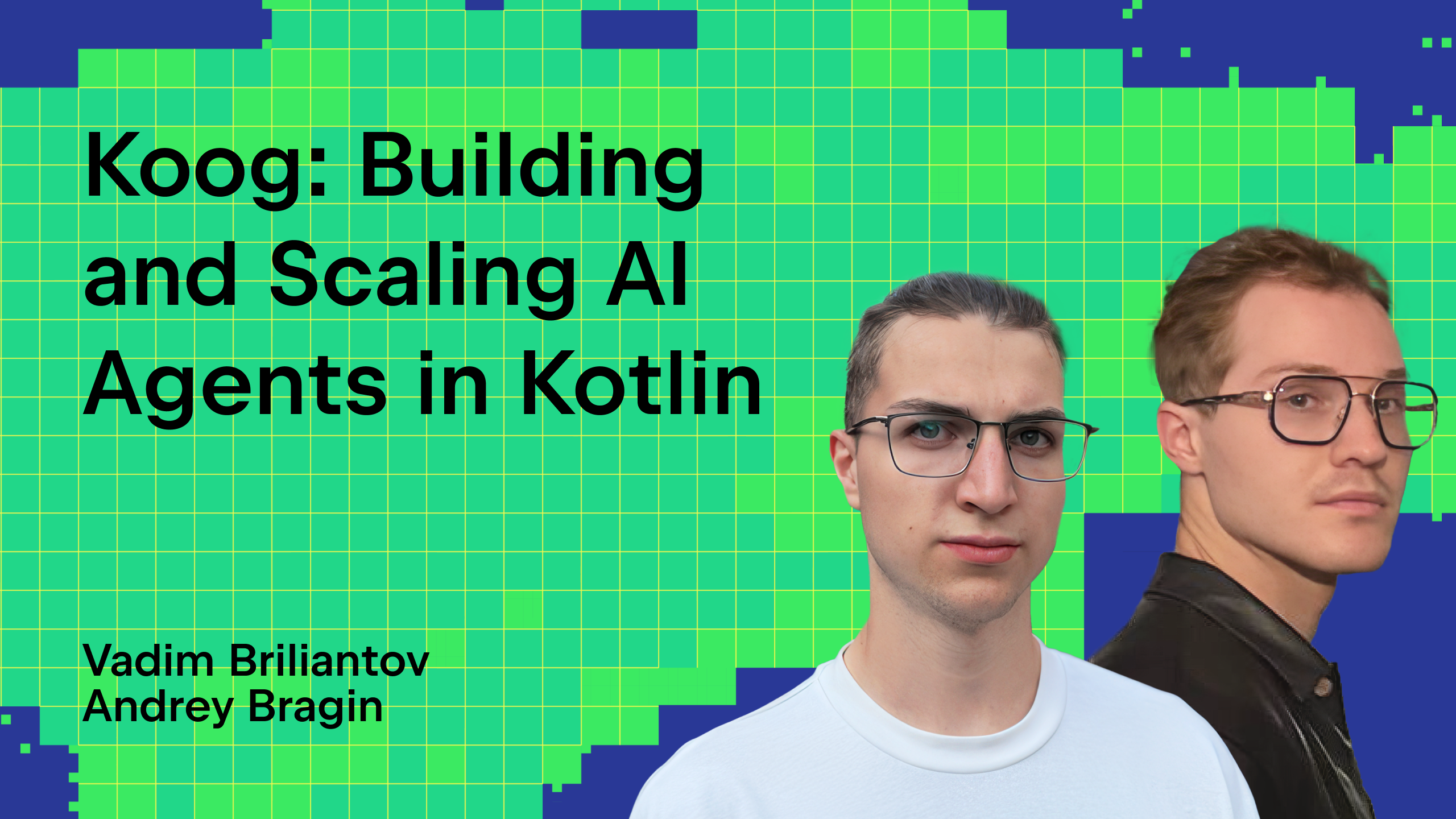
Are you ready to dive into the world of AI agents and create your own from scratch? We’ve got just the thing for you! Join us this August for a two-part livestream series about Koog, JetBrains’ open-source agentic framework that empowers developers to build AI agents entirely in Kotlin. Whether y…
I was testing my agent built on Koog, JetBrains' open-source framework for building AI agents in Kotlin. I fed it a task from SWE-bench-Verified, a real-world GitHub issue that tests whether AI can actually write code. For the first 100 messages, everything looked promising. The agent methodicall…
We’ve just released Koog 0.3.0, which comes with many updates that make building, running, and managing intelligent agents easier. This version focuses on durability, speed, observability, and smoother integration with real-world systems. If you’ve been exploring how to develop your own intellige…